India’s ancient culture is deeply embedded in spiritual values and cherishes humanistic values such as non-violence, truth, compassion, sharing and service to fellow human beings. Under the leadership of Mahatma Gandhi, India won freedom from British rule, on the strength of her ancient values of ahimsa and satya-non-violence and truth. One of the most ardent disciple of Mahatma Gandhi, who practiced his philosophy in letter and spirit was Vinoba Bhave. Leading an ascetic life of a sanyasi, he devoted his entire life in practical implementation of Gandhiji’s concept of rejuvenation of villages and upliftment of the downtrodden masses. Today, under the influence of materialist ideology of the West, India has bid good bye to the basic philosophy of Gandhi and Vinoba. Does it mean that they are irrelevant? Presently the world is witnessing widespread violence, terrorism, hatred, cut throat competition and survival of the fittest. The race among nations to arm themselves with nuclear bomb, coupled with merciless exploitation of natural resources is threatening the very existence of life on planet earth. This essay portrays the life of a great servant of modern India, Vinoba Bhave, who like Mahatma Gandhi, offers hope and optimism for a better tomorrow, to a troubled humanity intent on self-destruction.
Vinoba a true disciple of Gandhi, excelled even his Guru. Soon after he joined the ashram in 1916, Gandhiji told Vinoba, ‘Your love and character overwhelm me.’ In a letter to C F Andrews, soon after he joined the ashram, Gandhiji described Vinoba in following words, ‘ He is one of the few pearls of the ashram. They do not come like others to be blessed by the Ashram but to bless it, not to receive but to give’. (Narayan, p 4) Vinoba embraced Gandhiji as his father and Gandhiji reciprocated in full measure by treating him as his son. In a letter to Vinoba in 1918, Gandhiji wrote, ‘ In my view a father is in fact, a father who has a son who surpasses him in virtue. This is what you have made yourself.’( Narayan, p 51)
In October 1940, Gandhi Ji launched an individual satyagraha movement, unlike his usual mass civil disobedience movement, to express his opposition to British government for dragging India in the Second World War, without seeking the consent of the nation. He chose Vinoba as the first satyagrahi. Vinoba, hitherto unknown, Gandhiji introduced him by issuing a long statement and stated, “his devotion to daridranarayan has taken him to work in a village near Wardha. He believes that the real independence of the villages is impossible without the constructive programme of which khadi is the centre. He believes that the spinning wheel is the most suitable outward symbol of the non-violence which has become an integral part of the previous satyagraha campaign...He has abolished every trace of untouchability from his heart. He believes in the communal unity with the same passion that I have... In order to know the best mind of Islam, he gave one year to the study of the Koran in original. He therefore learned Arabic.” ( Narayan, p 3).
Early Life
Vinoba Bhave was born in a brahmin family on 11th September 1895, in a small township Gagode, which was part of erstwhile princely estate of Baroda, now in Kolaba district of Maharashtra. Vinayak, as he was known in childhood, spent his early years in his ancestral home at Gagode and was greatly influenced by his grand-father Shambhurao, who was a deeply religious person possessing modern outlook and believed in religious tolerance and social reform. Vinoba’s father Narharirao worked in Baroda. He was a textile technologist, possessed scientific outlook and experimented with dyes and colours. When Vinoba was around nine years, he moved to Baroda along with his mother and was admitted in a local school. He excelled in studies and always stood first. Mathematics was his favourite subject and he loved teaching it. With his scholastic temperament, he would sit in a local Library for hours and devour books. Vinoba’s mother was a very religious and pious lady and had a decisive influence on him to lead a saintly life. She remembered numerous Marathi bhajans by heart and would sing them with great devotion, while engaged in house-hold work. Setting her own example, she taught Vinoba the most important lesson of his life, “ First give food and then eat. Whosoever gives is God, and who does not share is devil’. ( Ahimsa, p 31). This lesson inspired Vinoba, later to launch his famous bhoodan movement. Vinoba observes, “Gita, my mother and spinning wheel are three pillars of my life, the entire Vishnu Sahastram is contained in these three.” (Ahimsa, p 21).
When Vinoba was ten he made up his mind to become a brahamchari. He was greatly inspired by three religious stalwarts - Gautam Buddha, Sant Ram Das and Shankaracharya. He came across a book which had given some rules a brahamchari is expected to follow in daily life and started practicing them. He found it very hard to follow, some of these rules, like the one which forbade a brahamchari to use shoe, as his foot would burn in summer while walking on bitumen surfaced road. After passing his matriculation examination Vinoba joined Intermediate class in a college in Baroda. But his heart was in becoming a renunciate. In March 1916, he boarded a train for Bombay to appear for Intermediate examination. But midway at Surat, he got down and took a train for Banaras, to begin a new life as sanyasi. Sometimes, earlier he had burnt his school and college certificate in fire. When his mother noticed it and protested, he told her that they will be of no use to him.
Vinoba’s family was deeply religious and did not stand in the way of children remaining celibate and dedicating themselves to serve the society. Both his younger brothers Balboka and Shivaji remained bal-brahamchari, like him and devoted themselves totally to social service. Vinoba had four brothers and one sister- Vinoba being the eldest. His youngest brother died in childhood and his sister also died young, soon after her marriage. Balkoba joined Gandhiji’s ashram and managed its clinic, as he had lively interest in naturopathy. Shivaji was a profound scholar of Sanskrit and Marathi literature and had set up a library for research work at Dhulia.
At Varanasi Vinoba started learning Sanskrit and ancient scriptures from some learned pundits. Two months at Varanasi, Vinoba came across a speech given by Gandhi Ji at the laying of foundation stone of Banaras Hindu University and was very impressed with his philosophy of ahimsa for attaining country’s freedom. He wrote a letter to Gandhi Ji and there was an exchange of correspondence with him. Gandhi Ji wrote to him, ‘ solutions to problems can’t be found by talking, but living upto ideals’ and it is better he comes and meet him. That made Vinoba immediately travel to Ahmedabad to meet Gandhiji.
An Ashram Inmate
Vinoba’s meeting with Gandhiji in June 1916, at his ashram in Ahmedabad , which was initially located at Kochrab and -later shifted to Sabarmati, changed the course of his life. He found in Gandhiji, Gita’s spirit of karmyog and sthithpragya and was overwhelmed. He became an ashram inmate and actively participated in all its activities which included grinding corn, cooking, study of scriptures to spinning and weaving and cleaning of latrines. With his mathematical approach Vinoba reduced spinning and weaving into a fine art to achieve maximum productivity. When hand-spinning and hand-weaving processes at the ashram culminated in the production of pure khadi, Vinoba’s dress became a dhoti of 35’’ width, subsequently reduced to 27”. This together with untailored cloth for his upper body became his dress, which remained unchanged throughout his life.
Vinoba was very keen to acquire deep understanding of ancient Indian scriptures and mastery over Sanskrit language, an objective for which he had gone to Banaras. After staying in the ashram for couple of months, he took a years leave from Gandhiji, to devote full time to studies and proceeded straight to his ancestral home town Wai, and became a disciple of a great Vedanta exponent who was stationed there. With his unflinching devotion , Vinoba acquired deep knowledge of Upanishad, Gita, Brahamsutra, and other scriptures and a mastery of Sanskrit language in six months time. Thereafter, he travelled extensively on foot to nearby districts of Maharashtra to understand the social and economic conditions of his people, as well as improve his own health which was very frail. During his wanderings, he camped at night in villages and delivered talks on Gita, in Marathi to village-folks, which often drew large appreciative crowd. The day he completed one year of leave, on the dot he returned to the ashram, much to the delight of Gandhiji.
Jamanlal Bajaj had come in close contact with Gandhiji and used to visit him frequently at Sabarmati ashram at Ahmedabad. He wanted him to open a similar ashram at Wardha and offered him land and facilities there. The idea appealed to Gandhiji and he suggested Vinoba to move there and set up an ashram.
Wardha — Sevagram Ashram & Paramdham, Pavnar
Vinoba moved to Wardha in April 1921, along with some of his trusted colleagues, which included his younger brother Balkoba and set up satyagraha ashram there in a bungalow and attached land given by Jamanlal Bajaj. All essential principles of community life as they were observed at Sabarmati were practiced. He, however introduced some new practices and made daily life more rigorous and disciplined. The Ashram inmates would do all the chores which included, cooking, washing clothes, sanitation and scavenging. Vinoba insisted that ashram should be totally self-reliant and made a rule that community will eat only what it would actually earn in the course of the day by dint of physical labour. Sometimes kitchen had to be closed for the evening as members had not earned enough for the meal, while at other times inmates had to remain content with only half-meal due to meagre earning of the day. For Vinoba, like his mentor Gandhiji, spinning and weaving was akin to worship and a means of national unity. Vinoba and other ashram inmates would spin and weave on takli and charkha for hours and made it a fine art. He was very concerned that even after hard work of eight to nine hours a day, the yarn and the clothe produced would not yield even a days living wage because of low prices.
To Vinoba, work could never be divorced from knowledge and he delivered regular classes in Gita and other scriptures to ashram inmates. The Ashram produced a wide range of dedicated followers who devoted their whole life to uplift the villages and serve the poor and downtrodden members of the society.
Vinoba was sent to jail several times between 1923 and 1932 for participating in the freedom movement. When he was released from Dhule jail in December 1932, he found that the Sewagram ashram was banned and locked by government due to its members participating in Civil Defence Movement . He decided to move to Nalwadi Village, about a kilometre and half from Wardha, inhabited by Harijans and worked for their upliftment. The Nalwadi ashram had about seven/eight workers including some women. They did community spinning and weaving, cooked food, washed clothes and utensils, did sanitation and scavenging work besides morning and evening prayers. As a result of untiring work by Vinoba and his band of workers a large number of temples and wells in some 300 villages nearby villages were opened for Harijans.
Gandhiji had taken a historic walk to Dandi, in March 1930, in connection with salt satyagraha, and had announced his decision of not returning to Sabarmati ashram till swaraj was achieved. At the invitation of Jamanlal Bajaj he moved to Wardha and later in April 1936 settled down in Sevagram Ashram four miles away. Meanwhile, Vinoba’s health was deteriorating due to his very rigorous life and was advised to go to a hill station to recuperate. Vinoba chose to move to Pavnar in early 1938, located on the bank of river Dham, six miles from Wardha which he felt was ‘an ideal retreat as good as a hill station’. At Pavnar Vinoba initiated a memorable experiment of eliminating money-economy or kanchan mukti as he called it, non use of coins or currency for running the ashram. Steps were taken to produce all the food-grains and vegetables for self- consumption. A small dairy was started. Khadi was spun and woven for use at the campus. Vinoba also set up a Brahma Vidya Mandir consisting exclusive of young girls drawn from different parts of the country and training them to be self-reliant.
For thirty years from 1921 to 1951, Vinoba stayed at one place- Wardha, at ashrams set up by him- Sewagram and Paramdham and plunged himself whole-heartedly in constructive work of study, teaching and experimenting with new ideas of improving the conditions of poor and downtrodden living in villages. He considered himself a labourer and performed work which was considered socially demeaning such as scavenging, digging fields and carpentry. He didn’t participate much in what was conventionally considered political activity, except when he was imprisoned. According to Vinoba he worked in the spirit of Gita of what is known as karm-yog and akaram- dedicating all your work to divine, with no expectation of result.
Prison as an Ashram
Vinoba was imprisoned first time in 1923 for hoisting national flag and was sent to Nagpur jail and later shifted to Akola jail. Criminal charges were imposed on him and he was asked to do hard labour of breaking stone. In one of his jail term, he was put in a solitary cell of nine ft by eight ft dimension and was not permitted to stir outside. The only article which the cell contained was a grinding stone (chakki) in one corner and a piss-pot in another. No books or writing material was allowed. But Vinoba remained unperturbed. He drew a schedule for the whole day to keep himself engaged. He would do meditation for 2-3 hours, walk in the room for ten hours and cover a distance of about ten miles and sleep for ten hours. The jail warden was stunned that despite such harsh conditions he was calm and quiet and shifted him to general ward.
Vinoba observed Gita’s philosophy of sthithpragya, while being incarcerated in jail. In Vinoba’s own words, “ The real experience of an ashram was felt in jail. Just a few clothes, one tumbler for water and a katora ( brass pot), that’s all one was allowed to possess. Every thing was regulated, bath, food , physical labour, the time you have to go for sleep and get-up- as per ringing of the jail bell. Fully regimented life! You were not allowed to fall ill. The food was tasteless. Plenty of time for meditation and contemplation. Where else can one lead such a disciplined life?” ( Ahimsa, p 111)
In 1932 Vinoba was in Dhulia jail for six months along with some 300 other political prisoners. Many of these prisoners were rebellious due to harsh conditions in the jail where they were required to do hard physical labour. Vinoba brought discipline among fellow prisoners and convinced them the value of physical labour to earn the right to bread. Thereafter they willingly grinded wheat for the entire jail staff and cooked their meals with Vinoba himself taking the lead. Vinoba would give motivational talk to fellow prisoners and created an ashram like atmosphere in the jail. It was in Dhulia jail Vinoba gave his weekly talk on Gita, which later became his celebrated commentary on this scripture.
In 1940, Vinoba was chosen as individual satyagrahi by Gandhiji and spent about a year and nine months in jail. In 1942 Quit India movement, Vinoba was again imprisoned and after a short stay in jail at Wardha and Nagpur, was shifted to Vellore, South India, as he was considered a dangerous prisoner. His ashram at Nalabari and Pavanar was sealed and confiscated. After about a years stay at Vellore, Vinoba was shifted to Seoni jail in Madhya Pradesh. He was released in May 1944, after fifteen months detention. He returned to Wardha in his ashram and resumed his constructive work.
While at jail in Vellore, Vinoba devoted his time in learning not only Tamil, but other principal South Indian languages such as Telegu, Kannada and Malayalam. Vinoba had a flair for languages. Besides his mastery in his mother tongue Marathi, he knew well Gujrati, Hindi, English and had working knowledge of French. At Wardha he engaged a maulvi to learn Arabic so that he could read Koran in original and has written a commentary on it. He also knew some Persian and Pali and tried to learn Chinese and Japanese. Whichever province he visited from Assam to Kerala, in connection with bhoodan movement, he tried to learn the local language so that he could connect with the local people. According to Vinoba, he was a student of world literature and greatly respected different literatures and men of letters.
Gita Pravachan
A very significant feature of Vinoba’s detention at Dhulia jail was his weekly discourses on Gita. They commenced on 21st February 1932 and continued till 19th June, every Sunday. During these four months Vinoba spoke extensively on every chapter of Gita. One of his fellow prisoner Sane Guruji kept detailed hand written notes of these lectures and prepared the manuscript for publication. This commentary on Gita titled Gita Pravachan is remarkable for its clarity and lucidity, giving examples from day today life, so that its fundamental message of doing one’s duty- karm-yog and leading an idealistic life, is assimilated by every section of the society, the youth, the house-holder and the elderly. I have read numerous commentaries on Gita by great saints and scholars, but found Vinoba’s Gita Pravachan the best and recommend its reading to anyone interested in understanding the key message of song celestial- Bhagwad Gita. The lectures were originally in Marathi and later translated in Hindi and all major Indian languages, as well as several foreign languages. So popular is the book that it has sold more than 21 lakh copies( Match 2017). Its Hindi version published by Sarva Sewa Sangh , Varanasi alone has sold 8.36 lakh copies and undergone 68 reprints, the Gujrati version has sold 4.86 lakh copies and Marathi 4.30 lakhs. I have the distinction of possessing a copy of Gita Pravachan autographed by Vinobaji with his remarks- ‘nitya pathnia’ — for reading daily. ( My wife when she was a student at Meerut, had rare privilege to see Vinoba and got the book autographed. )
The Bhoodan Movement
On the Independence day 15th August 1947, Vinoba was at Pavnar and worked in his farm as usual. No joy was felt in the ashram and there were no celebrations. The country was partitioned and there were communal riots in North-West India, killing large number of innocent people. Mahatma Gandhi’s passing away on 30th January 1948 was a devastating blow for Vinoba, but he kept his cool and he exhorted his fellow workers to remain calm and engage themselves in constructive activities, as true followers of Mahatma. The political independence threw new challenges and responsibilities. It was realised that the old ways of working won’t do. There was need for social and economic revolution.
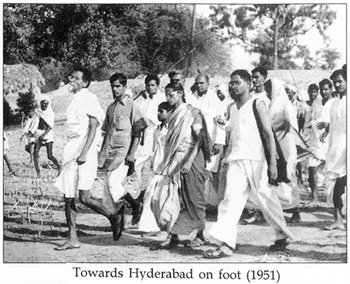
A conference of Sarvodaya workers was scheduled to be held at Shivrampalli near Hyderabad in April 1951. Vinoba decided to walk there on foot so that he could familiarise himself with the problems of people. At the conference of Sarvodaya workers Vinoba laid down five principles of constructive work: internal purity, village sanitation, reverence for physical labour, khadi contribution and peace brigade and asked workers to implement it in all sincerity. At that time, some areas in Telangana were very disturbed due to communist insurgency and people were living in fear and many people living in villages were leaving it for safety of cities. He decided to walk to the area and halted at Pochampalli. Some Harijan from the village came to meet him and told him that if they could get some land, they will work hard and will be able to earn their livelihood. There were forty Harijan families and on the basis of two acres per family they needed 80 acres. During the evening meeting Vinoba announced, if there is anybody who can help these Harijans. A young man stood up and announced that he has 200 acres and will donate 100 acres to the Harijans. This was a momentous event and Vinoba was overwhelmed with emotion. He felt a divine hand in this unforeseen development. Vinoba felt he has made a new discovery- people’s inherent goodness and consideration for fellow human beings which can be harnessed for national resurgence. That was the birth of bhoodan movement. For the next 51 days Vinoba trekked from village to village in Telangana and asked for land donation. He received as people’s voluntary donation of over 12,000 acres of land in 200 villages. Thus began bhoodan-yagnya which spread throughout the length and breadth of the country.
Soon after he returned to Pavnar from Telangana, Vinoba was invited to Delhi by Jawaharlal Nehru to meet the members of the Planning Commission, as the first Five Year Plan was being formulated. He decided to walk the distance, which took two months from mid-September 1951 to mid-November1951. At Delhi he camped at Rajghat, and commenced his day at 4 AM with morning prayers and religious discourses. He was unimpressed with the meeting with the Planning Commission as it did not focus on food self-sufficiency, generation of employment and land redistribution. His focus was on grass root development. Vinoba felt that most of the consumer goods should be produced through decentralised industries which would not only provide fuller employment but will also reduce strain on the transport system. In other words production should be simultaneously with distribution and consumption. Vinoba felt that because of the path shown by Gandhiji and cultural heritage of the country, people will whole-heartedly cooperate in his mission of rural rejuvenation, though distribution of land to the landless. The country has about 30 cr acre land — he was demanding one-sixth of that. Every family has five members, janta can be treated as a sixth member and therefore he may be given one-sixth share for that landless janta. According to Vinoba, he was not begging but asking people to donate so that problem can be solved peacefully.
In his trek from Pavnar to Delhi Vinoba had received gift of 35,000 acres of land. He continued with his bhoodan-yagna in UP, receiving warm response. In April 1952, at the Sarvodaya Conference at Sewapuri, Varanasi Sarva Seva Sangh, an all-India organisation of the Gandhians took over the task of bhoodan movement and the work of bhoodan began in all the regions of the country. From UP Vinoba went to Bihar. At Sarvodaya conference in Bodh Gaya in April 1954, Jay Prakash Narayan announced that he is dedicating his life to the bhoodan movement, as he found it to be the most practical method to bring in social revolution in the Gandhian philosophy. Now, the bhoodan movement had taken the shape of a countrywide movement. Workers of the movement were travelling throughout the country, mostly on foot; meetings and conventions were taking place in different parts of the country. From Bihar, Vinoba went to West Bengal, followed by Orissa. In Odisha he expanded the concept of bhoodan to gramdan, which implies surrender of the individual ownership and establishment of community control over land in a village. Instead of some bigger landowning individuals , the entire village puts its land under a common trust and also donates some portion of their income for the welfare of the poor. The tribal villages particularly in Koraput district welcomed this idea enthusiastically. Voluntary surrender of individual ownership of land by all the landowners of the village and its complete redistribution was a phenomenon of revolutionary dimension.
During his padyatra Vinoba had a very tight and disciplined schedule. He would get up at 3 AM and after performing nature’s duty and bath etc, offer morning prayer and commence walking at 4 AM, along with the small band of volunteers accompanying him. Normally in a day he would cover a distance of 25 to 40 km and reach the destination between 9 to 11 AM. This routine would of course be effected by the terrain, the weather and the distance to be covered to reach the next place of halt. At his destination he will have meetings with the local residents, persons engaged in constructive work programme and hold prayer meeting accompanied by pravachan at 5 PM and retire for sleep at 8 PM. Vinoba’s diet used to be very simple and frugal. He had given up sugar and salt when he was young as he didn’t want to be slave to his senses. During his walks his daily intake of food would be around 1200 to 1300 calories. Doctors were surprised how someone eating so little could have so much energy to walk. Vinoba would say that in his food first comes sky, followed by air, sun rays and water, while cereals are of least importance. The most important thing is feeling of contentment of what one eats, which is also key to good health.( Ahimsa, p 294-5 ) ( This author had the privilege of seeing Vinoba during his padyatra when he was a student of Intermediate, in District Basti, East UP. He came walking in the morning from Ayodhya and was welcomed by locals who lined up on the roadside. Later in the afternoon, he addressed the local residents in a college auditorium sitting on the dais with his back upright. He radiated an aura which mesmerised the audience.)
From Orissa, Vinoba went to Andhra Pradesh, followed by Tamil Nadu , Kerala and Karnataka covering the entire South India. From Karnataka, Vinoba travelled to Maharashtra, Gujarat, Rajasthan, Punjab and from there he entered Kashmir. In Kashmir, he went up to the Pir Panjal range which is at the height of 13500 feet and walked through waist deep rivulets incurring great physical risk. His journey to Kashmir was in his own words, ’a message of love’. From Kashmir, Vinoba turned south and came to Madhya Pradesh where a large number of dreaded dacoits of the Chambal valley surrendered before him. In July 1960, there were riots in Assam wherein linguistic minorities were targeted. At the request of Prime Minister Jawaharlal Nehru, he went there and spread the message of peace and brotherhood and also worked for the bhoodan movement. He stayed in Assam for one and a half year. While returning from Assam in September 1962, he came via East Pakistan (now Bangladesh) after taking permission from the Pakistan government . He stayed there for 16 days and spread the message of peace as well as bhoodan movement - which he thought could be replicated in other countries too.
The bhoodan movement had received enthusiastic support from political leadership and several state government’s enacted suitable legislations bringing the donations under the purview of law. Bhoodan Yagna Boards were established by the Government in each state to take care of the procedural work of accepting the land titles, taking possession and then re-distributing the land and confer titles to the landless bhoodan allottees.
Vinoba was following a very rigorous schedule of padyatra in his bhoodan campaign. But, in June 1964, ill-health forced him to stay at Pavnar Ashram. His health was no longer permitting padayatras. For 13 years of his life, he had walked without break, disregarding hot or cold weather or rains; crossing forests, mountains and rivers that lay in the way. During his Bhoodan-Gramdan padayatra, Vinoba would have walked around 80,000 kilometres.
Gradually, the bhoodan movement lost its momentum as there were serious problems in implementing its basic ideology. The distribution of land received under bhoodan proved to be a great challenge and could not keep pace with the donations. The work of distribution was complex and time-consuming and it could not proceed without the co-operation of the government’s revenue administration, which had been notorious for its inefficiency and corruption. This work also demanded technical knowledge and skill, which the workers in the Bhoodan-Gramdan movement generally lacked. The conversion of movement from Bhoodan to Gramdan created new set of problems. Land owners in villages were willing to consider parting with some land parcel that they really held in excess, but parting with entire holding and then accepting small part as private and rest as common was not acceptable to most. Out of respect to the revered leader villages agreed to gift the land on paper and then backed out. Transferred to landless families, the ability to cultivate and produce good output would depend on the ability to invest in inputs, but the landless did not have resources to invest other than family labour. The distribution of land to the landless proved to be a formidable challenge. A study cited by Vijay Mahajan [1] shows that as on March 2009, 50 years after the movement had peaked , shows that almost half the donated land was yet to be distributed. While 48,67,000 acres land was received as donation, only 25,00,000 acres could be distributed and 48.6 % remains yet to be distributed. The movement was also unevenly spread across the states. Bihar alone contributed almost half of all land donated in the country. Bihar, MP, UP and Rajasthan together contributed to more than 85 per cent of the total land donated.
The movement which had high visibility on the ground for about two decades, gradually lost its momentum and fizzled out. But one should not underestimate its contribution to national renaissance. At the time Vinoba launched his movement, Communism with its violent methods, to create so called classless society, was the dominant ideology in the world with Soviet Union and China setting an example. Vinoba thought that if the human race had to get out of the cycle of violence, then a non-violent solution to mankind’s trouble must be found. He found it in Gandhi’s core work and philosophy of which he was foremost bhakta (ardent follower). The movement showed the way how the new foundation of a society can be based on moral values based on love, cooperation and sharing of resources [2]. It was a programme based on high idealism, which also resulted in its undoing, given the nature of human foibles, greed and selfishness. But it was a very bold attempt at social experiment, nevertheless, which only a saint of Vinoba’s stature, unbounded energy and infinite faith in human beings goodness, could have dared to launch.
Messenger of Peace and Harmony
Uplifting the backward and downtrodden members of society and religious harmony by spreading the message of Sarva-Dharma- Sambhava was the passion of Vinoba’s life. Vinoba had made deep study and published selections from Koran and Bible and Dhammpada-essence of Buddhism. He wanted to achieve ‘ unity of hearts’ and felt it improper that human society be divided into sects and creeds. During his padyatra in Bihar in September 1953, he decided to visit Baidyanathdham temple along with Harijan brothers. The orthodox temple priests were opposed to the idea of Harijans entering the temple and attacked the party, seriously injuring some of them. But Vinoba forgave them and did not lodge a police complaint. Vinoba was in Jagannathpuri in March 1955 in connection with Sarvodaya conference and wanted to have darshan of Lord Jagannath. A French lady was with him, who was not allowed entry. Vinoba felt that Hindu dharma does not bar any person, irrespective of his or her religion to enter the temple and as a silent protest did not himself go inside the temple. Similar incident happened at the famous Gurvaoor temple in Kerala, which Vinoba wanted to visit along with his Christian friends and when they were barred , he himself declined to go. He, however, had contrary and pleasant experience at many other religious places. At Melkote temple, in South India associated with Ramunajacharya, he along with his Christian friends were warmly welcomed. At Ajmer where Vinoba had gone in connection with Sarvodaya conference, the Nazim of Dargah Sharif invited him along with his fellow participants which included ladies. During his walk in Kashmir with Muslim brothers, Vinoba will take a break at 11 AM and read and listen Koran Sharif. In 1960 Vinoba was in Amritsar and visited Golden Temple and extolled Guru Nanak’s message of universal brotherhood, shunning distinction of race and caste and condemned mixing religion with politics for partisan gain.
While in Kashmir Vinoba received a letter from Tehsildar Singh son of famous dacoit of Chambal Valley Man Singh, that he has been sentenced to death and would like to have his darshan before his execution. Vinoba was greatly moved and felt that no body is born as a dacoit and those who have made dacoity as their profession can be made to repent and reform. He asked Maj Gen Yadunath Singh, who belonged to the area and was touring Kashmir with him to go to Bhind- Mornea area and find out what can be done. Yadunath Singh prepared the ground for Vinoba’s peace mission. Vinoba came to Agra and walked to Chambal Valley area in May 1960. 20 dreaded dacoits surrendered before Vinoba, leaving behind their arm and ammunition. They were also able to meet members of their family. Vinoba was overwhelmed. In his own words, ‘ the experience which he had in this dacoit-infested area, he had never before. The whole atmosphere was filled with divine aura. It appeared that God has entered their heart and did a miracle.’ ( Ahimsa, p 195). The dacoits were later sent to jail. Vinoba didn’t want to interfere with judicial process and wanted law to take its own course. Later these dacoits were tried in Court of Law and given various spell of sentences. Tehsildar Singh’s death sentence was commuted to life imprisonment by the President. To have long term impact of his mission, Vinoba constituted Peace Committee under Sarva Sewa Sangh to do constructive work, so that people change the atmosphere of violence and crime in the Chambal Valley.
The Last Phase
After fifteen years of hectic schedule of walking and spreading the message of bhoodan-yagna, Vinoba received a call from his heart, to call it a day. On 7th June 1966 he had completed 50 years of his joining Gandhiji’s ashram. He decided that now onwards he will free himself with sthool-karya- active physical work and concentrate on sookshma karma-yoga - subtle inner directed work. In Soochma-karma-yog one does not have to abandon basic principles of karm-yog -daya, dan, dam — compassion, charity, courage, but continue to do it in a subtle way. He decided to take retirement from active participation with bhoodan work. Jay Prakash Narayan was now very actively engaged in the bhoodan movement in the country. Vinoba greatly admired him and felt he can leave the movement in his competent hands.
In 1970 Vinoba took another step forward towards his goal of total renunciation from worldly activities, of what he called - kshatriya-sanyas- confining himself to one location. He decided to stay at one place Brahma Vidya Mandir at Pavnar, the ashram he had established in 1959 primarily for women to attain spiritual advancement. But he would not participate in managing the ashram, that would be done by women themselves. While at Brahma Vidya Mandir, Vinoba decided to free himself with certain activities such as writing books and teaching, which were earlier his passion and called it granth- mukti and adhyapan- mukti , as he felt they create some kind of bondage. Gradually Vinoba disappeared from public view. He would . however issue occasional statements to ban cow slaughter and sometime undergo fast to draw the attention of the authorities. Complete ban of cow slaughter, was Vinoba’s cherished mission throughout his life.
At the ashram, Vinoba gradually rid himself of all worldly activities and devoted most of his time to meditation, contemplation and prayers. He would often observe silence- maun-vrat and sometimes extend it to long spell. In December 1974 he took maun vrat for a year. In normal course, Vinoba would engage himself in physical labour everyday and work for hours to keep the ashram neat and clean. As a sanyasi and self-realised soul Vinoba was fully conscious that as he was growing old, his body will inevitably perish one day. He remained completely detached from the body and was prepared to make an exit from the world, the moment a call comes from heaven. Vinoba was greatly impressed by Jain philosophy of santhara- making a voluntary exit from the world as a yogi rather than dying as a rogi- sick man. In November 1982, when he sensed that his end is near, Vinoba stopped taking food, water and medicine. The doctors attending him and his well wishers tried to persuade him to take some food and medicine but he did not relent . On 15th November 1982 Vinoba breathed his last and left his mortal body.
Vinoba’s Relevance Today
India and the world as we see today, is caught in internecine violence, conflict and hatred. Peace and tranquillity is missing from people’s life. Mankind is devoid of happiness and inner joy and caught in a spell of inner emptiness, depression and negativity. This is largely due to modern societies blind adherence to materialistic values and ignoring spiritual and moral dimension of human life. Historian Arnold Toynbee [3]]] has observed, “While mankind has made phenomenon economic progress due to advances of technology which has greatly increased Man’s wealth and power, but the ‘morality gap’ between Man’s physical power to do evil and his spiritual capacity for coping with this power has yawned wide open as the mythical jaws of Hell. During last 5000 years , the ‘widening gap’ has caused mankind to inflict on itself grievous disaster.” India had won her independence by adhering to its ancient values of peace and non-violence. She embraced a democratic constitution, with a view to achieve cherished goal of peace, prosperity and freedom. Tragically what we see on the ground in India, is a bandit democracy rather than benevolent. The sole aim of political class is to somehow capture power and use it promote their personal agenda. Elections are fought and won on the basis of narrow caste, communal and partisan considerations, creating hatred and enmity amongst the people. Even on issues like current Corona pandemic, which has spelled catastrophic misery on our fellow countrymen, the political class cannot work in unison and tries to score debating point with an eye on the next election.
Against such a background Vinoba’s life and message has great relevance for the country. A deeply spiritual person and an ardent follower of Gandhian philosophy, the core principles of his life were - ahimsa, satya , prem- non-violence, truth and compassion. He declared that, “sole purpose of his patyatra in connection with bhoodan was ‘union of hearts”. He repeatedly stated that all his life’s work is done with the purpose of uniting people’s hearts. (Ahimsa, p 247) . Today India faces unprecedented crisis due to corona pandemic. A large number of people have lost their jobs and livelihood, while many others have lost their dear ones leaving a permanent void in their life. They need a heeling touch of love, sympathy and compassion to enable them to reconstruct and move forward with their lives. Mother Teresa had rightly said, that there is more hunger for love and care in this world than there is for bread. Much like Mahatma Gandhi, it is saintly people like Vinoba Bhave who are needed in the world today, to instil in people’s mind the noble ideals of ahimsa and karuna — non-violence and compassion, so that people can live in peace and harmony as one single family. Hence Vinoba’s continued relevance in today’s troubled world, caught in senseless spell of violence, hatred and bigotry.
References
1. Vijay Mahajan, Bhoodan and Gramdan - Are They Relevant Today? Rajiv Gandhi Institute of Contemporary Studies, September 2020
2. For detailed elaboration refer to Dr Parag Cholkar, Bhoodan- Gramdan Movement, An Overview, Anasakti Darshan Combined issue: July 2010 - June 2011, Vol. 5 No. 2 and Vol. 6 No. 1, Gandhi Smriti and Darshan Samiti, New Delhi.
3. Arnold Toynbee, Mankind and Mother Earth, London: Book Club Association, 1976, pp 679-80.
# Kalindi (editor), Ahimsa Ki Talash-Vinoba ki Jeevan Jhanki - Vinoba ke Shabdo Me, Maitri- Special Issue 1985, Braham-Vidya Mandir Prakashan, Pavnar, In Hindi,(a reference to the book in the text is given as: Ahimsa)
# Shriman Narayan, Vinoba – His Life And Work, Bombay, Popular Prakashan, 1970, (reference to the book is given as: Narayan)
Courtesy: Mainstream, dt. 14.8.2021
*Dr B P Mathur is an author, social activist and spiritual seeker. He has served as Director National Institute of Financial Management and Deputy Comptroller & Auditor General.

