Showing posts with label Gita. Show all posts

परहेजी का प्रतिमा निरंजन

काफी बहस करने के बाद परहेजी गिने चुने पूजा पंडाल में जाने के लिए राजी हो गया।

सब जो दुर्गा माँ, दुर्गा माँ  कहके चिल्लाते हैं; उन सबके चिल्लाने से उस पंडाल में माँ कभी आती होंगी क्या? और भी कई अजीब किस्म के प्रश्न लेकर लालू पुजारी के साथ अक्सर उसका बहस हो जाता है।  थाल में सिन्दूर सजाकर लोग माँ, माँ करते हैं; और हड्डी मांस से बने माँ को दो रोज की रोटी तक नहीं देते।  ऐसे में क्या उनके कहने से दुर्गा माता आ भी सकेंगीं?

जहाँ हाड  मांस की माता को रोटी नसीब नहीं होता, वहाँ फिर उन्हें कौन पूछेगा?

बस परहेजी कई पूजा पंडाल से घूमकर तो आ गया , पर यह मान लेने से इनकार कर दिया कि हकीकत में किसी भी पंडाल में मान आई भी होंगी!  

 एक जगह से उसे गन्दा और अनपढ़ कहकर भगा दिया।  एक पड़ोस में पंडाल के मुखिया का बूढा बाबा ही घर में पड़े तकली से कराह रहा था; और पंडाल के पास कीमती पटाखे जलाये जा रहे थे; हिसाब सलटाया जा रहा था ताकि सरकारी पैसे हजम किये जा सकें।  गुलदस्ते सजाये जा रहे थे , ताकि नेताजी को भेंट में दिया जा  सके।  कुल मिलाहर उसे देवी माँ का दर्शन तो मिला , पर माँ को दो वक्त की रोटी ही नसीब नहीं हो रही थी। 

इसलिए अष्टमी संधि के थाल में पड़े सिन्दूर पर उसे कुछ ख़ास भरोसा नहीं रहा ; देवी माँ भी शायद मन ही मन कह रहीं थीं आदमी का सुधरना निहायत ही कठिन है।  सब खा पीकर बराबर करने वालों की टोली पंडाल में जमघट लगाकर नजरें गड़ाए बैठे थे; उन्हें खुद की भी फ़िक्र नहीं रहती; दूसर की क्या करेंगे ।

परहेजी को सिर्फ मास्टरजी के पास से एक पचास रुपये का नोट मिला ।  वो दौड़कर गया, और फलटण की माताजी को चार रोटी खरीद कर दे आया।  कमसे कम आज के दिन उसे मिला यही बहुत !

पंडाल जाकर प्रसाद खाने की बात कुछ बनी नहीं; कई जगहों से पहले ही अनपढ़, गंवार नालायक , और पता नहीं क्या क्या कहकर निकाल दिया गया । एक रावण को मारने के लिए कभी रामजी पूजा किये थे; अभी तो चारों और रावण ही रावण है; पता नहीं रामजी फिर कब पूजा करने के लिए आएंगे; आएंगे भी या नहीं।  

Bhagavadgita


General questions which strike our mind are as follows.

What is the Bhagavadgita?

What does the name Bhagavadgita mean?

What lesson does the Bhagavadgita teach about death?

What is Arjuna’s personal dilemma at the beginning of the Bhagavadgita, and how does Krishna advise him to act?

What is the Bhagavadgita’s significance to Hindus?

Bhagavadgita, (Sanskrit: “Song of God”) an episode recorded in the great Sanskrit poem of the Hindus, the Mahabharata. It occupies chapters 23 to 40 of Book VI of the Mahabharata and is composed in the form of a dialogue between Prince Arjuna and Krishna, an avatar (incarnation) of the god Vishnu. Composed perhaps in the 1st or 2nd century CE, it is commonly known as the Gita.


On the brink of a great battle between conflicting groups of the same family, Arjuna is suddenly overwhelmed with misgivings about the justice of killing so many people, some of whom are his friends and relatives, and expresses his qualms to Krishna, his beloved charioteer—a combination of bodyguard , guide and court historian. Krishna’s reply expresses the central themes of the Gita. He persuades Arjuna to do his duty as a man born into the class of warriors, which is to fight whenever instances come, and whenever situation wants it Krishna’s argument incorporates many of the basic teachings of the Upanishads, speculative texts compiled between 1000 and 600 BCE, as well as of the philosophy of Samkhya Yoga, which stresses a dualism between soul and matter (mind-body dualism). He argues that one can kill only the body; the soul is immortal and transmigrates into another body after death or, for those who have understood the true teachings, achieves liberation (moksha) or extinction (nirvana), freedom from the wheel of birth, death and rebirth. Krishna also resolves the tension between the Vedic injunction to sacrifice and to propagate a record of good actions (karma) and the late Upanishadic injunction to meditate and inculcate knowledge (jnana). The solution he provides is the path of devotion (bhakti). With right understanding, one need not renounce actions but merely the desire (kama) for the fruits of actions, acting without desire (nishkama karma).


The moral impasse is not so much resolved as destroyed when Krishna assumes his doomsday form—a fiery, gaping mouth, swallowing up all creatures in the universe at the end of the eon—after Arjuna asks Krishna to reveal his true cosmic nature. In the middle of this terrifying epiphany, Arjuna apologizes to Krishna for the many times when he had rashly and casually called out to him as a friend. He begs Krishna to return to his previous form, which the god consents to do, resuming his role as intimate human companion of the warrior Arjuna.


The Gita has always been cherished by many Hindus for ensuring access to spiritual guidance, but it achieved new prominence in the 19th century, when the British in India lauded it as the Hindu equivalent of the New Testament and when American philosophers—particularly the New England Transcendentalists Ralph Waldo Emerson and Henry David Thoreau—considered it to be the pivotal Hindu text. It was also an important text for leaders of Indian  Freedom Struggle, some of them wrote commentaries and essays on it.  This Holy Scripture secured a prominent position in the realm of Indian Spirituality as the stand of common devotees of the Divine continued exploring the glory of their beloved master through discourses and narratives of the Holy Scripture.


Memories of a Padayatri


 By Kalindi

Geography books in school mentioned that the highest rainfall in the country was registered in Cherrapunji and that Cherrapunji was situated in Assam. My acquaintance with Assam was limited. I had to look into the map to place Assam geographically. However today I was travelling in the same Assam - taking part in a padyatra with 'Bhoodan Wale Baba', that is with Vinobaji. It was pouring heavily and Baba was loudly chanting Vedic mantras.

Sa No Vrishtidiwaspri
Sa No Vajmanvarnam
Sa Nah Sahastrinirisha

He was also singing the meaning of this Vedic mantra - "Let there be rains from the heavens, this is the blessing of God on us, let there be no disturbance in our song.”

Rains, rains and rains! It has been raining incessantly for the past two days. Everyone is worried. How will Baba take out his padyatra tomorrow? He will start walking from 0300 am. The village is in the interior on the edges of the forest. It is possible that the area might be flooded. With rains in Assam, can the floods be far behind? All wanted that Baba should not proceed, halt here for some time, and start again once the rains die down. Amal Prabha Baidev (in Assam elder sister is called Baidev) represented all of us. She spoke to Baba in her calm polite manner, "Baba please do not go tomorrow, there might be floods ahead...." Baba replied, "If there is no road to go ahead then I will not go, but if there is any way, then I will have to go. I will go as far as I can go." Baidev told the other followers that Baba was determined to move forward, so let us think about the best route that we can take, and we should ensure that the best of our men should stay around him tomorrow.

Looking at the circumstances, it was decided that apart from local supporters, only a few others who had come with Baba should move ahead with him. I was among those chosen to go with him. At 0300 am the next day, eight to ten persons started with Baba. It was raining very heavily, and we had to walk along the railway bridge, and I remembered a story told by Baba.

Baba used to study in school at that time and he was walking along a railway bridge. Below it was a drop of 30 to 40 feet and there were gaps between the railway tracks - and Baba felt scared. He slowly crossed the railway bridge. But then to overcome his fear, he started crossing the bridge everyday. And then he also started running on the bridge. Once he was in the ashram at Ahmedabad, he went to Mount Abu on foot with Kaka Saheb Kalelkar. While coming back they were crossing a railway bridge. The train was chugging in from behind. Kaka Saheb crossed the bridge. Baba's eyes were weak, and it was evening, so he could not see everything clearly. He realised that he would not be able to cross the bridge if he walked. He had practice of running on a railway bridge. So he used his mathematical brain to gauge the distance between the two planks of the railway track and started running on a set rhythm so that his feet fell on the planks. The train was coming nearer, that much he could understand. He could not see Kaka Saheb, but he could hear his voice which said - 'Vinoba, jump left', and so Baba jumped and he was saved. Baba said, "If I had become afraid at that time, I would not have been able to run, would not have been able to think, and the matter would have ended there." Today Baba was looking at the surging water below and walking confidently on the bridge.

Finally the bridge ended and we came to the road. We walked a little distance and we saw a big water body. No it was not a water body. It was flood waters. The road ahead was under water. It meant that now we would have to walk on water. Immediately, four strong followers surrounded Baba. The water reached Baba's chest level. Manohar Bhai was walking with a small box on his head in which he carried Baba's milk that he had for breakfast. One of the followers held him steady. The water was flowing above my head and that of Swarna Behan, who was from Assam. Our hands were strongly held by some of the other followers of Baba. My legs were not touching any firm land. On that day, my legs which were not used to swimming were as if swimming on their own. We 'marched' in this fashion for around a furlong and then we reached a village.

The villagers were not aware that we were coming. No one ever came to their village. No one even came to ask for their votes. The village mukhia (chief) was called to one of the bigger villages and the matter was explained to him. So even though they knew that Baba would be coming, they did not believe that Baba would actually be reaching their village during the floods. Nothing had been done to welcome Baba. People were sitting in their houses. However, when they saw Baba coming towards the village, wading through the water, his body soaked and feet naked, the entire village ran towards him. Now it would appear that this is an exaggeration, but I saw this scene in that village on that day. Some started wiping Baba's feet with their clothes, while some started cleaning it with their tears. No, I am not repeating an old tale from the Puranas, but something I witnessed with my own eyes.

A similar difficult journey was at Kashmir's Pirpanjal range, which is 13,000 feet high. There we reached Mandi Loren and a heavy storm broke out. We had to halt there for six days. We got wireless messages from the Prime Minister, the President, asking Baba not to proceed any further and go to Kashmir by plane. However Baba said, "If it continues to rain like this, and we are unable to cross the mountain then I will take it as a message of the almighty and not go to Kashmir. I will return to Punjab. I only move according to 'His' will. Therefore, I have decided that if I cannot go by the mountain route, I will not go by any other route." Finally, the rain stopped and Baba crossed the mountain to reach Kashmir valley.

This storm had completely destroyed the life in Mandi Loren. Houses were collapsing. There was not a single dry place left. Baba and his followers' were living in tents. Underneath there was grass and on top the trampoline tent. An entire Muslim family was trapped when their house collapsed on them. Apart from the aged grandfather and his 12 year old grandson no one else survived. However, then the grandfather also died, and soon after the child became ill - he had acute diarrhoea. At that time Baba's travel arrangements were being looked after by Army general Yadunath Singh. He had great devotion towards Baba. He and Bahen Kusum Deshpandey who was part of the team, tried to save the boy, but failed. The boy died. Baba was present near the body. He read out mantras from the Vedas and Agni mantra and then read out verses of the Koran.

Hey Shant Jeev
Laut Chala Apne Prabhu Ki Aur
Too Ukase Prassanna Aur Woh Tujse Prassanna
So Mere (Allah Ke) Daso Mey Sammilit Ho Ja
Aur Mere Swarg Mey Pravishta Ho Ja
Oh silent one
You are returning to your Lord
You are happy with him, and he is happy with you
Come and join my servants (Allah's)

Baba used to say that all his efforts are aimed at uniting the hearts of people. The Bhoodan padyatra was such an attempt. Once the people asked Paigamber Hazrat Mohammad, you always talk about Allah, why don't you perform a miracle. Mohammad Sahab said, "I am an illiterate person and all of you are so learned, yet you all listen to me, is this not a miracle?" What Hazrat Mohammad had said was correct. Similarly, in the era of airplane travel, covering 50,000 miles on foot, was this anything less than a miracle? Baba used to say, "In 14 years, 50,000 miles have been covered. We have circled the earth twice, because the earth's diameter is around 24,000 miles."

His every act was for the last man standing in the queue. That is why he chose padyatra as his means to spread his message. There was great thought behind choosing padyatra. Bhave said, "After we got swaraj and especially after Mahatma Gandhi's death, I used to think a lot about the path we should be taking for development. During that time, I had the opportunity to travel by train, and that too in the first class, which I was doing for the first time in my life, for whatever reason that might be. I travelled across a vast swath of the country. I gained a lot. However, I kept on thinking. Will travelling in this manner help to give a push to ahimsa (non-violence)? Will the aim of changing society in the direction that we want be fulfilled? Ultimately, the train journey, was it based on ahimsa') It was not. How was the railways made? The money that was used in travelling, how did it come? All these thoughts came to mind. Also such a fast means of travel which did not contribute to seriousness of thought and only created a flutter in people, could it be the correct medium of travel to spread the message of ahimsa? If we use this means of travel, will we ever be able to reach the common man?"

His work and thought were based on the 'last man'. He had no other desire apart from thinking about the 'last man'. His worship to God had merged into service for the 'last man’. He once said, "My Krishna is not there in Mathura only. Wherever I go, I get a glimpse of my Krishna. You are all my Krishnas and I have come for your darshan." Another time, in jest he said a very important thing, "I do not get much opportunity to see my face in the mirror. There is no need for it. I always think that in all the differently dressed people, I see myself. I have always felt this way during my travels. Wherever I have travelled, people never thought that I had come from some other state. Rather, the love and affection which the people of Maharashtra showered on me was the same everywhere else also."

Baba's padyatra started at 0300 am or 0400 am every day. Generally, he reached his destination in four to five hours. In state like Bihar, it sometimes took longer. Most of the roads were dusty and uneven. That day we had to reach Gaya. And the next day .we had to reach Narayana's Sokhodavera ashram. It was winter. At around 2100 pm to 2130 pm, Narayana was wearing warm clothes and armed with a torch he was getting ready to go somewhere. There was a small band of workers with him. Some of them had shovels and some had hoes in their hand. Where were they going, and what were they going to do? We came to know that there were two routes - one was a long route, but the condition of the shorter route was bad. So Narayana and his men mended the short route so that people could walk on it. When Baba came to know of this, he was very happy.

During the padyatra the target was to cover one village every day. (In Tamil Nadu sometimes we used to walk twice in a day and cover two villages). Walking under the open sky and fresh air we used to get the smell of the habitation whenever we came near a village. Baba had a very sensitive nose and he used to smell even the faintest of odour. That is why his mother used to tell him "Vinya, you must have been a lion in your previous birth because your power of smell is very strong and you also like to travel." So the moment Baba got the smell he used to say "The village is nearby, we have reached our destination." And soon enough the people of the village could be seen coming towards us with their traditional instruments, all ready to welcome to Baba. There used to be a huge crowd to greet Baba and the crowd used to be there till late in the night. In some places it used to appear that there was a fair going on. And small shops also sprung up.

One day in the evening, after the public meeting ended, a chana seller came up to Baba. He took out loose change and some notes from his soiled and torn pocket and told Baba, "I do not have any land, therefore whatever I have earned today, I am giving it in your name." This was not a donation of any rich money lender or industrialist or a top ranking official, but that of a poor man, who had a heart that was rich.

There was such a woman in a village in Maharashtra. Her husband had died. She used to make papads to provide for herself and her children. She had read or heard somewhere that Baba was asking for land for the poor, and that the Baba was asking for a certain percentage of a person's earning as donation. So she sent her donation to Baba through a Sarvodaya worker. The donation amount was not very big, but the value of the feeling with which she gave the donation was unique.

When Baba received the donation, he stood silent for two minutes and then he wrote a letter to that woman. "Looking at your condition, even one paisa of your income given as donation would be sufficient. I am sending you a 'daan patra:' to you, fill it up and send it back to me. Use the money you have given as donation to purchase goods made in the cottage industries. I will consider as your donation, the money you save in purchasing products made by cottage industry instead of machine-made products. Send me the details at the end of the year."

The aim of Bhoodan and property donation was not to accumulate land or cash. Making this very clear, Baba said, "Wherever I take donation, I expect there is a churning of the soul, a cleansing of the self, a feeling like a mother's love for her child, friendship and love for the poor. Where feeling for others is engendered. Here feeling of hatred cannot survive. Bhoodan yagna is an experiment in non-violence, a life-changing experiment."

The Bhoodan Ganga had reached every small village in the most interior of places. It was an unforgettable experience. A village surrounded by trees, a hut made of grass and hay for Baba to stay. For the public meeting any elevated platform was sufficient, and the audience the poor farmers, all dishevelled would be listening attentively. Baba's address was in very simple language, and in the end there was question and answer with the audience. People used to participate in it very naturally. The meetings did not have the glamour or show of big public meetings in cities, but the exchanges touched the heart. It was a very natural unpretentious exchange, which reminded one of Jesus Christ, of a villages sage going around preaching from the Upanishads, of Adi Shankaracharya crossing forests and mountains while preaching.

It is amazing the ease with which Baba connected with these innocent villagers. However an anecdote reveals the same. Baba was putting up in a room of a dilapidated school in a little village. At 1030 am, we were chanting Vishnu Sahasranaam. Hearing the mantras people started coming to the room and soon every inch of space was taken up and people were even standing near the windows and doorways. It was as if the entire village had attended this event. The room was so crowded that even fresh air could not enter the room. At that time, it had not been many days that I had joined Baba. After the chanting was over, I told Baba that I was feeling a bit queasy during the chanting, and the entire room was filled with the stench of sweat. Usually Baba never tolerated anything unclean, but that day he looked at me for a few seconds and said, "If you feel squeamish about the smell of sweat, you will never be able to make friendship with humanity." It was only one sentence, but for a person like me who was bred in the city and was so called cultured, it was a big lesson. If a man feels squeamish in the presence of another human being, then it is negating humanism.

Instead of big cities, it is in these small villages that one comes across such memorable events. For instance, it was monsoon time. We were travelling in the Vardha district of Maharashtra. That was a very important day. The country's new Prime Minister Lai Bahadur Shastri was coming to meet Baba. The village was very fortunate, but it was so poor that there was not a single pucca house there. There was no school either. The government officials were very worried. Finally one house was selected and the owner of the house and his family were shifted elsewhere and the house was vacated for Baba. 'House' meant a small kitchen, a small room with a window and outside the room a shed where cattle were kept. That day we decorated the kitchen. We placed sheets there, covered the 'chulha' with a piece of cloth and put a lantern on it, because the room was very dark. The Prime Minister walked half a furlong as he was coming to meet a Rishi. Baba got up and welcomed him. Both of them were talking when a strong wind came up, and very slowly red chillis and skin of the onions that had been kept on the loft of the house started falling on them - it was as if the poor man was welcoming the dignitaries with the best of what he had in the house! Can any other country provide such a scene!

They were crossing the jungle in Balaghat district of Madhya Pradesh. During padyatras Baba used to keep silent till sun rise. After sunrise, he used to meet the guests, and if there were no guests he used to meet and talk to his own people, discuss issues and even share jokes with them. The entire atmosphere was filled with joy and happiness. This was named - ' Jangam Vidyapeeth'. Till this Vidyapeeth opened, till there was darkness, everyone was silent. Only the noise of footsteps was there. Sometimes one could hear the tune of morning raag from far away. Sometimes, the noise of a wild animal could be heard. At that time, I used to stay in the back row reading from the Gita with the help of a torch. However, the moment Baba started speaking, I used to run and reach the front row. That day also I was in the back row, when the organiser came searching for us and said, "you all should not remain in the back row. There are leopards in this jungle and they attack from the rear, so come to the front rows do not remain in the back." We said, "you are scaring us unnecessarily. We have been walking in this jungle for the past two days, but we have not seen any leopards." Nevertheless he took us to the front row. A little later he pointed out, "See, see the ground below you," And we saw fresh footprints of a leopard, and it could be clearly seen for quite a distance. There is a saying in Marathi, if God is protecting someone, then who can injure them.

It was in one of these villages on the edge of the jungle that school children presented Baba with a copy of Goswami Tulsidas's bhajans. Baba used to tell people about this very proudly in his speeches. Once he crossed Punjab and entered the Kashmir valley, he saw a Christian mission there. An old lady was standing there waiting for Baba. She wanted to greet Baba. Baba asked her whether she had Scofield reference Bible. She went inside and gave a copy to Baba. In Punjab, Shiromani Gurudwara Sabha resident gave copy of Granth Saheb in the Nagri script. Baba used to say, "Those who love others, will be loved by all."

Like the way people of all languages and states accepted Baba as then- own, similarly all the religious communities supported Bhoodan yagna from their hearts. Before Baba reached Kerala, four churches issued an appeal to the people, "This man is doing the work of Jesus Christ, and therefore all the Christians brothers should give their full support to this movement." Once during his travels in Uttar Pradesh, when Baba reached Sarnath, the Buddhist Bhikshus welcomed him and said, "We accept Vinobaji's claim that through Bhoodan movement he is only taking forward Lord Buddha's concept of Dharma chakra." When the Bhoodan yatra reached Malabar, the Muslims there said, "Whatever you are saying, the same thing has been said in the Koran."

In 1959, the Sarvodaya Sammelan was held in Ajmer. Then the Nazim of Dargah Sharif had invited Baba and said in his invitation, "We want that Vinobaji should come to the dargah. We want to welcome him, because our great saints also believed in love. I am also extending the welcome to all those who are with Vinobaji. All are welcome." The next day, thousands of people of all castes and religions, male and female, went to the dargah. The Shankaracharya of Kanchi also gave his blessings to the Bhoodan yagna.

Before the start of the Bhoodan yatra, when he used to undertake sadhna in the ashram, it was as if he was preparing for Antodaya (serving the last man in the queue). He used to weave for as long as 10 hours at a stretch, experiment with spinning, work in the fields for hours and even go to the open toilet in the villages.

During the initial days of the padyatra, there was regular spinning, and there was labour donation at the villages.

Baba stayed for one month in Indore, a city in Madhya Pradesh. During his stay, a 'clean Indore week' was observed. Baba used to go to different parts of the city and take part in the cleanliness drive. He said that he would clean the public toilets. Talking about that experience, he said, "Stool, urine and water - everything was there. The women from the sweeper community used to clean it every day. I too cleaned it with my hands. I had gloves on my hands when cleaning the toilets, but even then after returning home I wanted to wash my hands repeatedly. While cleaning the toilets, I was wearing slippers at that time, but I removed them, because as the name suggests, they were 'slippers' and if I slipped wearing them, it would have created more problems. On top of that it was raining. After cleaning the toilets my feet became very dirty. Washing them at home did not solve the problem, and I felt, 'Should I bask my legs before a fire?'" That is why Baba called this, "Sauch Karya" and said that a solution should be found so that no human being has to do this work.

After Madhya Pradesh, Baba went to Assam. In one and half years he covered the state twice. From there he had to go to West Bengal. To reach West Bengal from Assam, one had to go through East Pakistan, now Bangladesh. He went to West Bengal through that route and he had an 18- day padyatra in East Pakistan.

After taking leave from Assam, five of us along with Baba entered Sonar Bangla, or East Pakistan. In the first village we went, there was a small welcome meeting. Two small children around 12-13 were sitting right in front. They were wearing tattered clothes, had lathis in their hands, and were sitting like kings. They looked at me and smiled as if we had a deep friendship. Then I suddenly realised that these two children had come to the village in Assam to see Baba. I asked, "where do you belong? - India or Pakistan". They said, "our house is here, but we often go to the other side to roam around. At that moment, Baba started his discourse, "I do not see any difference between Hindustan and Pakistan. The same air, the same land, the same people and the same heard." I thought, two more words should be added, "the same devotion and the same language." Because truly, the welcome that we got was similar to the one we received in Hindustan.

There was a big public meeting in the evening. Five to six thousand people took part. And day after day the number of people who took part in public meeting kept on increasing. At Noakhali ashram there were only a few workers who were looking after the entire task. There was lack of manpower, so there could not be much advanced publicity about Baba and his work. However, the message spread around to the people -"A fakir has come from Bharat and he has brought the message of love." And people used to come in droves. Sometimes, it used to happen that Baba would address thousands at a public meeting and within half an hour of his returning to his room, a similar size crowd would have gathered there. The convenor, Cham Chaodhary used to come and say, "Baba you will have to come again, a crowd of new people have gathered. They will not go back without listening to you." So within half an hour a new public meeting started and Baba again gave his discourse. Often during music festivals, the crowd gives the 'Once more* call to the musicians, but have you ever heard of a 'Once more' call for a public meeting?

On the very first day of hearing Baba's discourse, a gentleman had a calling from his heart. Of his four acre land, he donated one acre. Baba kept one hand on his shoulder and said, I will ask Allah's blessing for you. Hearing this, the man started crying. Announcing the donation, Baba said, "Imtatah has started with this land". Meaning the doors have opened. The donor who gave the land was called Abdul Khalik Munshi.

For 13 years, the padyatra (journey on foot) continued in India. Then it continued in car for four to four and half years. It covered all the states and almost all the districts. During the journey, Baba used to be among the people throughout the day and in the evening when all work was completed, he used to talk with his followers. They are such good memories, that one wants to recall them all the time and gain pleasure from them. And this pleasure is never ending. The message of those talks was that of self-development. Sometimes, Baba used to ask about someone's health and then talk about the spirituality and the relationship between the two. If someone had any angst within he used to tell the person to serve and overcome his anger. He used to discuss the bhajans of Tulsi, Tukaram, Gyandev and other sants and within all this there were jokes and general merriment. From our point of view these sessions were the best part of day. All the difficulties of the journey vanished in joy.

The motive of Bhoodan was not simply to bring about economic progress and economic equality. The main aim was to inspire the people to a higher religion. To ensure that man rises above himself, and moves towards self- enlightenment. He always used to say that for revolution there has to be change in society from outside and change of 'chitta' (or self) from inside. Simply by changing society from outside will not help matters. Baba also gave an equation for this - like H20 is water, C2H is revolution -which means changing two parts of Chitta or self and changing one part of society or 'Samaj'. This was the formula for revolution. He used to say that our saints and other great men have taught us the path of cleaning the 'chitta', we should follow that path and only then can man and society change and there will be equality.

It was to ensure that some universal or fundamental work continued being done in society that he set up six ashrams in the country during his day s of Bhoodan yatra. The main aim behind Bhoodan movement and setting up of ashram was the same - to encourage self-analysis. Bhoodan yagna still remains a unique thing in the entire world. Of the six ashrams, the Brahmavidya Mandir in Pavnar, where women gather for community meditation, was the place where Baba spent the last 12 years of his life.

Brahmavidya Mandir Pavnar
(District Wardha) 442111, MH, India.

King of Kindness


- By Mark Shephard*


"Jai jagat! - Victory to the world!." - Vinoba

Once India gained its independence, that nation's leaders did not take long to abandon Mahatma Gandhi's principles.

Nonviolence gave way to the use of India's armed forces. Perhaps even worse, the new leaders discarded Gandhi's vision of a decentralized society - a society based on autonomous, self-reliant villages. These leaders spurred a rush toward a strong central government and an industrial economy as found in the West.

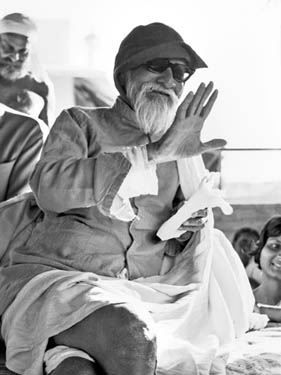
Vinoba-Bhave
Yet Gandhi's vision was not abandoned by all. Many of Gandhi's "constructive workers" - development experts and community organizers working in a host of agencies set up by Gandhi himself - resolved to continue his mission of transforming Indian society.

Leading them was a disciple of Gandhi previously little known to the Indian public, yet eventually regarded as Gandhi's "spiritual successor": a saintly, reserved, austere individual called Vinoba.

In 1916, at the age of 20, Vinoba was in the holy city of Benares trying to come to a decision.

Should he go to the Himalaya Mountains and become a religious hermit? Or should he go to West Bengal and join the guerillas fighting the British?

Then Vinoba came across a newspaper account of a speech by Gandhi. Vinoba was thrilled. Soon after, he joined Gandhi in his ashram. (An ashram is a religious community - but for Gandhians, it is also a center for political and social action.)

As Vinoba later said, he found in Gandhi the peace of the Himalayas united with the revolutionary fervor of Bengal.

Gandhi greatly admired Vinoba, commenting that Vinoba understood Gandhian thought better than he himself did. In 1940 he showed his regard by choosing Vinoba over Nehru to lead off a national protest campaign against British war policies.

After Gandhi's assassination on January 30, 1948, many of Gandhi's followers looked to Vinoba for direction. Vinoba advised that, now that India had reached its goal of Swaraj - independence, or self-rule - the Gandhians' new goal should be a society dedicated toSarvodaya, the "welfare of all."

The name stuck, and the movement of the Gandhians became known as the Sarvodaya Movement. A merger of constructive work agencies produced Sarva Seva Sangh - "The Society for the Service of All" - which became the core of the Sarvodaya Movement, as the main Gandhian organization working for broad social change along Gandhian lines.

Vinoba had no desire to be a leader, preferring a secluded ashram life. This preference, though, was overturned by events in 1951, following the yearly Sarvodaya conference in what is now the central Indian state of Andhra Pradesh. At the close of that conference, Vinoba announced his intention to journey through the nearby district of Telengana.

He couldn't have picked a more troubled spot.

Telengana was at that moment the scene of an armed insurrection. Communist students and some of the poorest villagers had united in a guerilla army. This army had tried to break the land monopoly of the rich landlords by driving them out or killing them and distributing their land.

At the height of the revolt, the guerrillas had controlled an area of 3,000 villages. But the Indian army had been sent in and had begun its own campaign of terror. Now, many villages were occupied by government troops during the day and by Communists at night. Each side would kill villagers they suspected of supporting the other side. So most villagers lived in terror of both sides.

The government had clearly shown it would win, but the conflict wasn't nearly over by the time of the Sarvodaya conference. Vinoba hoped to find a solution to the conflict and to the injustice that had spawned it. So, refusing police escort, he and a small company set off on foot.

On April 18, the third day of his walk, Vinoba stopped in the village of Pochampalli, which had been an important Communist stronghold. Setting himself up in the courtyard of a Muslim prayer compound, he was soon receiving visitors from all the factions in the village.

Among the visitors was a group of 40 families of landless Harijans. (Harijan was Gandhi's name for the Untouchables, the outcasts from Hindu society. Literally, it means "child of God.") The Harijans told Vinoba they had no choice but to support the Communists, because only the Communists would give them land. They asked, Would Vinoba ask the government instead to give them land?

Vinoba replied, "What use is government help until we can help ourselves?" But he himself wasn't satisfied by the answer. He was deeply perplexed.

Late that afternoon, by a lake next to the village, Vinoba held a prayer meeting that drew thousands of villagers from the surrounding area. Near the beginning of the meeting, he presented the Harijans' problem to the assembly. Without really expecting a response, he said, "Brothers, is there anyone among you who can help these Harijan friends?"

A prominent farmer of the village stood up. "Sir, I am ready to give one hundred acres."

Vinoba could not believe his ears.

Here, in the midst of a civil war over land monopoly, was a farmer willing to part with 100 acres out of simple generosity. And Vinoba was just as astounded when the Harijans declared that they needed only 80 acres and wouldn't accept more!

Vinoba suddenly saw a solution to the region's turmoil. In fact, the incident seemed to him a sign from God. At the close of the prayer meeting, he announced he would walk all through the region to collect gifts of land for the landless.

So began the movement called Bhoodan - "land-gift." Over the next seven weeks, Vinoba asked for donations of land for the landless in 200 villages of Telengana. Calculating the amount of India's farmland needed to supply India's landless poor, he would tell the farmers and landlords in each village, "I am your fifth son. Give me my equal share of land." And in each village - to his continued amazement - the donations poured in.

Who gave, and why?

At first most of the donors were farmers of moderate means, including some who themselves owned only an acre or two. To them, Vinoba was a holy man, a saint, the Mahatma's own son, who had come to give them God's message of kinship with their poorer neighbors. Vinoba's prayer meetings at times took on an almost evangelical fervor. As for Vinoba, he accepted gifts from even the poorest - though he sometimes returned these gifts to the donors - because his goal was as much to open hearts as to redistribute land.

Gradually, though, the richer landowners also began to give. Of course, many of their gifts were inspired by fear of the Communists and hopes of buying off the poor - as the Communists were quick to proclaim.

But not all the motives of the rich landowners were economic. Many of the rich hoped to gain "spiritual merit" through their gifts; or at least to uphold their prestige. After all, if poor farmers were willing to give sizeable portions of their land to Vinoba, could the rich be seen to do less? And perhaps a few of the rich were even truly touched by Vinoba's message.

In any case, as Vinoba's tour gained momentum, even the announced approach of the "god who gives away land" was enough to prepare the landlords to part with some of their acreage.

Soon Vinoba was collecting hundreds of acres a day. What's more, wherever Vinoba moved, he began to dispel the climate of tension and fear that had plagued the region. In places where people had been afraid to assemble, thousands gathered to hear him - including the Communists.

At the end of seven weeks, Vinoba had collected over 12,000 acres. After he left, Sarvodaya workers continuing to collect land in his name received another 100,000 acres.

The Telengana march became the launching point for a nationwide campaign that Vinoba hoped would eliminate the greatest single cause of India's poverty: land monopoly. He hoped as well that it might be the lever needed to start a "nonviolent revolution" - a complete transformation of Indian society by peaceful means.

The root of oppression, he reasoned, is greed. If people could be led to overcome their possessiveness, a climate would be created in which social division and exploitation could be eliminated. As he later put it, "We do not aim at doing mere acts of kindness, but at creating a Kingdom of Kindness."

Soon Vinoba and his colleagues were collecting 1,000 acres a day, then 2,000, then 3,000. Several hundred small teams of Sarvodaya workers and volunteers began trekking from village to village, all over India, collecting land in Vinoba's name. Vinoba himself - despite advanced age and poor health - marched continually, touring one state after another.

The pattern of Vinoba's day was daily the same. Vinoba and his company would rise by 3:00 a.m. and hold a prayer meeting for themselves. Then they would walk ten or twelve miles to the next village, Vinoba leading at a pace that left the others struggling breathlessly behind. With him were always a few close assistants, a bevy of young, idealistic volunteers - teenagers and young adults, male and some female, mostly from towns or cities - plus maybe some regular Sarvodaya workers, a landlord, a politician, or an interested Westerner.

At the host village they would be greeted by a brass band, a makeshift archway, garlands, formal welcomes by village leaders, and shouts of "Sant Vinoba, Sant Vinoba!" ("Saint Vinoba!")

After breakfast, the Bhoodan workers would fan out through the village, meeting the villagers, distributing literature, and taking pledges. Vinoba himself would be settled apart, meeting with visitors, reading newspapers, answering letters.

In late afternoon, there would be a prayer meeting, attended by hundreds or thousands of villagers from the area. After a period of reciting and chanting, Vinoba would speak to the crowd in his quiet, high-pitched voice. His talk would be completely improvised, full of rich images drawn from Hindu scripture or everyday life, exhorting the villagers to lives of love, kinship, sharing. At the close of the meeting, more pledges would be taken.

There were no free weekends on this itinerary, no holidays, no days off. The man who led this relentless crusade was 57 years old, suffered from chronic dysentery, chronic malaria, and an intestinal ulcer, and restricted himself, because of his ulcer, to a diet of honey, milk, and yogurt.

As the campaign gained momentum, friends and detractors alike watched in fascination. In the West, too, Vinoba's effort drew attention. In the United States, major articles on Vinoba appeared in the New York Times, the New Yorker - Vinoba even appeared on the cover of Time.

By the time of the 1954 Sarvodaya conference, the Gandhians had collected over 3 million acres nationwide. The total eventually reached over 4 million. Much of this land turned out to be useless, and in many cases landowners reneged on their pledges. Still, the Gandhians were able to distribute over 1 million acres to India's landless poor - far more than had been managed by the land reform programs of India's government. About half a million families benefited.

Meanwhile, Vinoba was shifting his efforts to a new gear - a higher one.

After 1954, Vinoba began asking for "donations" not so much of land but of whole villages. He named this new program Gramdan - "village-gift."

Gramdan was a far more radical program than Bhoodan. In a Gramdan village, all land was to be legally owned by the village as a whole, but parceled out for the use of individual families, according to need. Because the families could not themselves sell, rent, or mortgage the land, they could not be pressured off it during hard times - as normally happens when land reform programs bestow land title on poor individuals.

Village affairs were to be managed by a village council made up of all adult members of the village, making decisions by consensus - meaning the council could not adopt any decision until everyone accepted it. This was meant to ensure cooperation and make it much harder for one person or group to benefit at the expense of others.

While Bhoodan had been meant to prepare people for a nonviolent revolution, Vinoba saw Gramdan as the revolution itself.

Like Gandhi, Vinoba believed that the divisiveness of Indian society was a root cause of its degradation and stagnation. Before the villagers could begin to improve their lot, they needed to learn to work together. Gramdan, he felt, with its common land ownership and cooperative decision-making, could bring about the needed unity.

And once this was achieved, the "people's power" it would release would make anything possible.

Vinoba's Gramdan efforts progressed slowly until 1965, when an easing of Gramdan's requirements was joined to the launching of a "storm campaign." By 1970, the official figure for Gramdan villages was 160,000 - almost one-third of all India's villages!

But it turned out that it was far easier to get a declaration of Gramdan than to set it up in practice. By early 1970, only a few thousand villages had transferred land title to a village council. In most of these, progress was at a standstill. What's more, most of these few thousand villages were small, single-caste, or tribal - not even typical Indian villages.

By 1971, Gramdan as a movement had collapsed under its own weight.

Still, the Gramdan movement left behind more than a hundred Gramdan "pockets" - some made up of hundreds of villages - where Gandhian workers settled in for long-term development efforts. These pockets today form the base of India's Gandhian movement. In these locales, the Gandhians are helping some of India's poorest by organizing Gandhian-style community development and nonviolent action campaigns against injustice.

As for Vinoba, he returned to his ashram for the final time in June 1970, after thirteen years of continual marching and five more of presiding over the "storm campaign."

During his final years, Vinoba continued to inspire new programs - for instance, Women's Power Awakening, a Gandhian version of women's liberation. He also launched an ongoing campaign against "cow slaughter" to try to halt the butchering of useful farm animals, a practice destructive of India's traditional agriculture.

In the mid-1970s, Vinoba and some close followers became estranged from Sarva Seva Sangh when he opposed the nationwide protest movement of fellow Gandhian Jayaprakash Narayan against the government of Prime Minister Indira Gandhi (no relation to the Mahatma). The "JP Movement" led to Indira Gandhi's infamous declaration of Emergency and then indirectly to her temporary ouster from office. In the long run, the value of that movement's accomplishments proved open to question, and much of Vinoba's criticism of it was borne out.

Vinoba died on November 15, 1982. In his dying, as in his living, he was deliberate, instructive, and, in a way, lighthearted. After suffering a heart attack, Vinoba decided to "leave his body before his body left him." He therefore simply stopped eating until his body released him.

Terminologies


Some Terminologies used in Gita

  1. Whenever there is Arjuna-like honesty, straightforwardness and total surrender to God, even a state of despondency attains the character of yoga.1 It is the churning of heart which brings this about. The First Chapter of the Gita has been called Arjuna-vishad-yoga. I prefer to call it simply Vishad-yoga, as Arjuna provided only an occasion for the discourse. The Lord did not take the form of Pandurang for the sake of Pundalik2 alone. Pundalik provided only a pretext for His descent on earth. We see that the Lord is standing for thousands of years at Pandharpur to redeem us all, ignorant creatures as we are, held captive by the bonds of this-worldliness. Similarly, although Arjuna provided an immediate cause for the overflowing of the Lord's compassion in the form of the Gita, it is really intended for all of us. That is why the general term vishad-yoga is more befitting for the Gita's First Chapter. Beginning from this vishad-yoga the Gita's teaching keeps on growing like a magnificent tree, finally bearing the fruit of prasad-yoga (God's grace) in the concluding Chapter. God willing, we too would reach that destination during the term of our imprisonment.
  2. The Gita's teaching begins from the Second Chapter. At the very outset, the Lord enunciates the cardinal principles of life. The idea is that once the fundamental principles, which are to form the foundation of life, are well-grasped, the way ahead would be clear. In my view, the term sankhya-buddhi3 in the Second Chapter stands for the basic principles of life. We have now to take up the consideration of these principles. But before that, it is better to have a clear understanding of the Gita's terminology.
    The Gita has a penchant for using old philosophical terms in new senses. Grafting new meanings on to old terms is a non-violent process of bringing about revolution in thinking. Vyasa is adept in this process. This is the secret of the great potency and strength of the language of the Gita and its ever-freshness and vitality. Different thinkers could therefore read different meanings in the terms used by it in the light of their experiences and according to their needs. In my view, all those interpretations could be taken as valid from their respective standpoints and yet we can have a different interpretation of our own without ruling out any of them.
  3. There is a beautiful story in an Upanishad which is worth recounting here. Once gods, demons and human beings went to Prajapati (the Creator) for advice. Prajapati gave all of them only one word of advice: the single syllable 'द' (da). The gods said, "We are given to passions and sensual pleasures. So, Prajapati has advised us 'daman' (दमन) (subduing and conquering them)." The demons said, ''We are given to anger and cruelty. So, Prajapati has advised us to cultivate 'daya' (दया) (compassion)." The human beings said, "We are greedy and are always hankering after possessions. So, Prajapati has advised us to practise 'dan' (दान) (charity and sharing)."4 Prajapati approved all these interpretations, as all of them had arrived at their interpretations through their own experiences. We should bear in mind this story while interpreting the Gita's terminology.

Performance Of Swadharma Through The Body

  1. Three cardinal principles have been enunciated in the Second Chapter -
    (i) The atman (the Self) is deathless and indivisible.
    (ii) The body is insignificant and transient.
    (iii) Swadharma must be followed.
    Out of these, Swadharma is in the nature of duty to be performed while the other two principles are those that need to be understood.
    I have already said something about swadharma. For each of us, swadharma is 'given.' It comes to us naturally; we do not have to go out looking for it. We did not drop from the sky but were born into a stream of existence. Society, parents, neighbours, all existed before we were born. To serve the parents who gave me life, to serve the society that succored me is my natural dharma. Our swadharma thus takes birth along with us; it can even be said that it is already there for us before our birth. In fact, fulfillment of swadharma is the very purpose behind our birth. Some people say that swadharma is like one's wife and say that the bond of swadharma is as inviolable and indissoluble as the bond of marriage.5 But I do not think that this simile is quite apposite. I would rather say that swadharma, like one's mother, is not chosen but pre-determined. No matter what sort of person she is, there is no denying her motherhood. This is precisely the case with swadharma. In this world we have nothing else to rely on. To disown one's swadharma is to disown oneself, to commit suicide. Only in harmony with it can we move forward. That is why we should never lose sight of it.
  2. Swadharma should, in fact, come easily and naturally. But because of several temptations and delusions this does not happen or becomes extremely difficult. Even if it is practised, the practice gets vitiated. The temptations and delusions which strew with thorns the path of swadharma have various forms. However, on analysis, we find only one thing at the bottom of it all: a restricted and shallow identification of oneself with one's body. I, and those related to me through the body, set the limits of my expansion. Those outside the circle are strangers or enemies. Besides, the attachment is restricted to only the physical bodies of the 'I and mine'. Caught in this double trap, we start putting up all sorts of little walls. Almost everyone does this. One man's enclosure may be larger than another's but all surround themselves with a wall. It is no thicker than their skin. One man's enclosure is the family, another's the nation. One wall divides the so-called upper and lower castes, another divides the people on the basis of religions. Wherever you turn you see nothing but walls. Even in this jail, we differentiate between ordinary convicts and political prisoners. It is as if we cannot live without such walls. But what does this result into? This has only one result-multiplication of the germs of mean and vicious thoughts and destruction of the healthy state of swadharma.

Awareness Of The Self That Transcends The Body

  1. In this situation, commitment to swadharma is not enough. Constant awareness of two other principles is necessary. One of them is: 'I am not this feeble and mortal physical body; the body is only the outer covering.' The other is: 'I am the Self that is imperishable, indivisible and all-pervading.' These two together constitute a whole philosophy of life.
    The Gita values this philosophy so much that it enunciates it at the very outset and only thereafter brings in the concept of swadharma. Some people wonder why such abstruse philosophical theorems are there at the very beginning. But I think that if there are any verses in the Gita whose place cannot at all be changed, then these are such verses.
    If this philosophy is imprinted on the mind, the practice of swadharma will not appear difficult. In fact, it will be difficult not to practise it. It is not difficult to comprehend that the Self is eternal and indivisible and the body is worthless and transient, as these are the truths. But we should reflect over them, ruminate constantly over them. We should train ourselves to belittle the body and exalt the Self.
  2. Look! This body is for ever changing, caught in the cycle of childhood, youth and old age. Modern scientists say that every seven years it is renewed and not a drop of old blood remains. Our ancestors believed that this takes twelve years. That is why they prescribed a period of twelve years for study, penance, atonement of sins or wrongdoings etc. We often hear that mothers failed to recognise their own sons after years of separation. The body changes every moment, dies every moment. Is this body you? Twenty four hours a day its sewers operate, and despite indefatigable scavenging it remains unclean. Is this body you? No, the body is dirty; it is you who wash it. It gets ill; it is you who treat it with medicine. It fills three and a half cubits of space; you are free to roam in the whole of the cosmos. It changes endlessly; you observe those changes. It is open to death; you accept it. When the distinction between your body and yourself is so clear, why do you say that only that which relates to the body belongs to you? And why do you grieve for the death of the body? The Lord asks: "Is the destruction of the body a cause for grief?"
  3. The body is, in fact, like a garment we wear. We can put on a new garment as the old one fortunately gets worn out. Had one and the same body stuck to the Self for ever, the Self would really have been in a sad plight. That would have stopped all growth, extinguished all joy and dimmed the illuminating power of knowledge and wisdom. Hence, perishing of the body is not a thing to grieve over. Had the Self been perishable, that would indeed have been a cause for grief. But the Self is imperishable. The eternal Self clothes itself in a succession of bodies. That is why it is utterly wrong to get attached to a particular body and its relations and grieve over their loss; and it is also wrong to consider some as kin and others as aliens. The universe is a beautifully woven whole. Were we to cut up the undivided Self, immanent in the whole universe, into bits of separate selves using the body as a pair of scissors like a child who willfully cuts a whole piece of cloth with a pair of scissors, would it not be the height of childish folly, and moreover, an act of extreme violence?
    It is really a pity that India, the land where Brahmavidya (the science of realising the Brahman6) was born, is now teeming with innumerable incongruent groups and castes. We are so much afraid of death that one wonders whether such fear has any parallel anywhere else in the world. No doubt, it is a consequence of a long period of subjection; but then one must not forget that it is also one of the causes of that subjection.
  4. We hate the word 'death'. It is considered inauspicious. Jnanadeva had to write regretfully: 'अगा मर हा बोल न साहती । आणि मेलिया तरी रडती ।।' ('They cannot bear the word 'death' and cry over death.') If someone dies, what tears! What wailing! Why, we think all this is our duty! People go to the extent of hiring professional mourners!7 Even when death is imminent, we do not tell the patient. He is kept in the dark even when a doctor has told us that the patient cannot live. Even doctors do not speak plainly to the patients and go on pouring medicines down their throats till the last moment. If, instead, the doctor were to tell the patient the truth, give him courage and direct his thoughts towards God, what a help that would be! But it is feared that this little pot might crack of shock before its time. But can death ever come before the right moment? Besides, even if it comes a little earlier, what does it matter? We should certainly not be loveless and hard-hearted; but attachment to the body is not love. On the contrary, unless attachment to the body is overcome, true love does not emerge.
    When we are freed of that attachment, we would realise that the body is an instrument for service; and then the body would gain its true dignity. But today we regard pampering of the body as the sole purpose of our lives. We have totally forgotten that life is to be lived for the fulfillment of swadharma and to do this one has to look after the body. It should be given proper nourishment; but there is no need to indulge the palate. It is all the same to a ladle whether you use it to serve shrikhand (a sweet dessert) or plain curry; it feels neither happy nor unhappy. The same should be the case with our tongue. It should, of course, be able to distinguish between different tastes, but should not feel any pleasure or repulsion. The body is to be paid its due hire, and nothing more. A spinning wheel has to be oiled regularly to keep it in working condition; in the same way we should provide fuel to the body so that we can take work from it. If that is our approach, the body, although having little intrinsic worth, would become worthy and valuable and gain true dignity.
  5. But, instead of using the body as an instrument, we lose ourselves in it and stunt our spirit whereby the body, which has little intrinsic worth, is made of less worth. That is why the saints vehemently say, 'देह आणि देहसंबंधें निंदावी। इतरें वंदावी श्वानसूकरें।'('One should censure the narrow confinement to the body and the blood-relations and venerate others, even the pigs and the dogs!') Do not, therefore, worship the body and its ties all the time. Learn to relate to others as well. The saints are thus exhorting us to broaden our horizon. Do we ever open our hearts to others outside our narrow circle of friends and relatives? Do we ever try to identify ourselves with others? Do we let our swan-Self-the bird of the spirit-escape from the cage of the body and breathe freedom? Does it ever occur to us that we should widen the circle of our friends continually so as to ultimately encompass the whole world and feel that the whole world is ours and that we belong to the whole world? We write letters to our relatives from the jail. What is special about it? But would you write to a thief convict-not a political prisoner-whom you have befriended here, after his release?
  6. The soul is ever restless to reach out to others. It longs to embrace the whole world. But we shut it up in a cell. We have imprisoned the soul and are not even conscious of it. From morning till evening, we are busy minding the body. Day and night we worry about how fat or thin we are. One would think that there was no other joy in the world. But even beasts experience the pleasures of the senses. Will you not like to taste the joy of giving, the joy of controlling the palate? What joy there is in giving away your full plate of food though you too suffer from hunger? A mother, when she works hard for the sake of her child, knows something of this joy. In fact, even when one draws a small circle around the 'I and the mine', one is unconsciously striving to experience the joy in the enlargement of the self. Thereby the self, otherwise encased in the body, is released to a limited extent and for a little while. But what sort of a release is this? It is like a prisoner coming out of his cell into the prison courtyard. This hardly satisfies the self's aspirations. It wants the joy of unbounded freedom.
  7. In short, (i) a seeker after truth should avoid the by-lanes of adharma (un-righteousness) and paradharma (the dharma which is not his own) and take to the natural and straight path of swadharma. He should follow it steadfastly. (ii) Bearing in mind that the body is transient, it should be used for the sake of the performance of swadharma and should be given up for its sake when the need arises (iii) Remaining ever aware of the eternal and all-pervading nature of the Self, the distinction of 'mine' and 'thine' should be removed from the mind. The Lord has expounded these three principles of life. One who follows them would undoubtedly have, some day or the other, the experience of 'नरदेहाचेनि साधनें, सच्चिदानंदपदवि घेणें।'(using the human body as an instrument, one can reach the exalted state of sat-chit-ananda.8).

The Way To Harmonise The Two Principles: Renunciation Of The Fruit Of Actions

  1. The Lord has no doubt enunciated the principles of life. But this, in itself, does not serve the purpose. These principles were already there in the Upanishads and the Smritis. To restate them is not the Gita's unique contribution; that lies in its explaining how these principles are to be translated into practice. It is in solving this great problem that the ingenuity of the Gita lies.
    Yoga means nothing but the art of translating the principles of life into practice. The word 'sankhya'means principles or science while 'yoga' means art of translating it into practice. Jnanadeva's saying, '
    योगियां साधली जीवनकळा।' ('The yogis have mastered the art of living'), proclaims this as an experiential fact. The Gita includes both sankhya and yoga, the science and art respectively; and has thus achieved completeness and perfection. When science and art unite, the beauty of life blossoms into its fullness. Science, by itself, remains on an abstract level. One may know the theory of music, but only when one has mastered the art of singing, the many-splendoured beauty of nad-brahma (the Supreme Truth revealed in the sound of music) comes to life. That is why the Lord has taught not only the principles, but also the art of applying them to life. What then is this art-the art of practising swadharma and realising that the body is of little worth and that the Self is imperishable and indivisible?
    Behind a man's action there are generally two types of attitude. One of them is: 'If I do something, I shall definitely enjoy the fruit of my actions; I am entitled to it.' The second attitude is: 'I shall not act at all if I am not going to enjoy the fruit of my actions.' The Gita prescribes an altogether different attitude. It says: 'You must, of course, act; but do not have any claim over the fruit of your actions'. One who acts is certainly entitled to enjoy the fruit of one's actions, but one should voluntarily give up that right. Rajas9 says, "I shall act only if I am going to enjoy the fruit of my actions." Tamas says, "If I am not going to enjoy the fruit, I shall not act at all." These attitudes are like two sides of the same coin; there is nothing to choose between them. One should go beyond both of them and adopt pure sattva; one should act and then relinquish the fruits of actions; and act without any claim over them. The desire for the fruit should never be there, either before or after the action.
  2. The Gita, while asking us not to have any desire for the fruit of actions, insists that the work must, however, be perfect. The work of a desireless doer can rightfully be expected to be better than that of one driven by desire for the fruit. The reason is that, because of attachment to the fruit, the latter is bound to waste at least some time and energy in day-dreaming about it. On the other hand, every moment of the desireless doer's life and every bit of his energy would be spent in the work in hand. A river knows no respite; wind takes no rest; the sun shines for ever. Likewise, a desireless doer is ever engaged in unremitting service. Who else can then achieve perfection in work, if not he? Secondly, mental poise, the equanimity of mind is a great quality; and the desireless doer has this quality in his own right. When equanimity of mind is combined with the skill of the hands, even an ordinary work of an artisan is bound to be better and more beautiful. Moreover, the difference between the outlook of a desireless doer and of one with attachment to desires is also conducive in making the former's work better. A man having an eye on securing the fruits looks at the work from a selfish point of view. In his view, the action as well as its fruits are exclusively his own. Therefore, he does not feel that any negligence in the work is a moral lapse. For him, it may, at the most, cause the output to be defective. But a desireless doer has a moral sense of duty towards his work. He is, therefore, extremely alert to avoid any shortcomings therein. Hence his work is bound to be more flawless. Thus, from whatever angle one may see, falatyaga (renunciation of the fruits of actions) proves to be a sound and effective principle. That is why it could be called a sort of yoga or the art of living.
  3. Leaving aside the matter of desireless action, there is in the action itself a joy which you cannot find in the fruit. Total absorption in one's own work is an everlasting spring of joy. Were you to offer any amount of money to an artist for refraining from painting, would he agree? Certainly not. If you tell a farmer not go to the field, not to graze the cattle or draw water from the well, and offer him as much grains as he wants, he would certainly not agree to it if he were a true farmer. A farmer goes to the field in the early morning. There the Sun-god welcomes him. Birds sing for him. Cattle gather around him. He caresses them with affection, casts a loving glance at the plants. There is a sattvik, sublime joy in all this. This joy, in fact, is the true and main reward of his work. Compared to it, the material fruit of action is secondary.
    When the Gita takes a man's attention away from the fruit of his actions, it increases hundredfold his concentration in his work through this ingenuity. When the doer's mind is free from the desire for the fruit, his absorption in his work attains the character of samadhi. Hence his joy is also hundred times more than that of others. Looked at from this angle, it is clear that the desireless action is itself a great reward. Jnanadeva has rightly asked, "The tree bears fruits, but what fruit could the fruit bear?" When the body is used for the desireless pursuit of swadharma, such pursuit itself is the beautiful fruit that the body bears. Why then look for any other fruit? Why should a farmer who has sown wheat, sell it and eat a bread of millets? Why should one not eat what he grows? But the ways of the world are strange. The Gita asks us to refrain from such behaviour. It asks us to relish work, to rejoice in it, to be fully absorbed in it and draw life-blood from it. To act itself is everything. A child plays for the joy of playing. He does get the benefit of exercise thereby, but he does not think of this benefit. His joy is in playing only.

Renunciation Of The Fruit Of Action: Two Examples

  1. The saints have demonstrated this in their lives. Shivaji, the king, had great respect for saint Tukaram because of the latter's exemplary devotion to the Lord. Once he thought of honouring him and sent a palanquin to fetch him. But Tukaram was deeply distressed by the arrangements made to honour him. He thought to himself, "Is this the reward for my devotion to the Lord? Is it for this that I worship Him?" He felt that the Lord, by placing this fruit of the worldly honour in his hands, was pushing him away from Him, and said,

"जाणोनि अंतर । टाळिसील करकर ।
तुज लागली हे खोडी । पांडुरंगा बहु कुडी ।।"

'O, Lord! This prank on your part is not good. You may be trying to push me away from you by offering this little bribe. You may be thinking of getting rid of me this way. But I am not so naive as to be taken in by this. I shall cling firmly to your feet.'
Devotion (Bhakti) is the swadharma of the devotee (Bhakta). His 'art of living' lies in ensuring that the devotion does not get distracted by the lure of other worldly gains.

  1. The life of Pundalik shows us an even more profound ideal of renunciation of the fruit of actions. Pundalik was devoted to the service of his parents. Pleased with this, Lord Pandurang rushed to meet him. Pundalik refused to give up his duty to welcome the Lord. The service of the parents was, for him, a form of worship of the Lord. He was not taken in even by the great temptation offered by the Lord. Someone may rob others to provide comforts to his parents; or a patriot may seek the prosperity and glory of his own country at the cost of other countries. Such 'worship' of one's parents or one's country is nothing but selfish attachment; it is not true worship. Pundalik was not trapped in such attachment. It was indeed true that the Lord Himself was standing in front of him; but was that His only form? Was the whole creation lifeless like a corpse before He appeared in that form? Pundalik told the Lord, "O, Lord! I fully understand that you have come to bless me. But I believe in the doctrine of 'this also.' I do not think that you alone are God. You certainly are God; but my parents too are God to me. And since I am engaged in their service, I am not in a position to pay attention to you. Please, therefore, forgive me." Saying this, he pushed a brick for the Lord to stand on, and again became engrossed in his work. Saint Tukaram refers to this with loving admiration in a lighter vein-

'कां रे प्रेमें मातलासी । उभें केलें विठ्ठलासी ।
ऐसा कैसा रे तूं धीट । मागें भिरकाविली वीट ।।'

('Why have you become so presumptuous in Love? You made Lord Pandurang stand at your door! How have you become so audacious as to throw a brick to Him to stand on!')

  1. The doctrine of 'this also' which Pundalik applied is a part of the ingenuity in the renunciation of the fruit of actions. A man who renounces the fruits of actions is totally absorbed in his work and his outlook is broad, tolerant and balanced. He does not, therefore, get entangled in the web of abstruse academic arguments and remains firm on his own standpoint. He does not argue that 'not that, this alone is true.' He holds, humbly but firmly, that 'this also is and that also is, but for me, this alone is'-that he should stick to his own swadharma.
    A householder once went to a sage and asked him, "Must one leave his home-that is, give up one's worldly duties and responsibilities as a householder-in order to attain moksha ?" The sage said, "Certainly not. King Janaka attained moksha while living in the palace, fulfilling his duties as a king; then where is the need for you to leave your home?" Later, another man went to the sage and asked him, "Sir, can one attain moksha without leaving the home?" The sage replied, "Who says so? Had it been possible, were persons like Shuka10 fools to renounce their homes-that is, this-worldly attachments-for the sake of moksha?" Later, they met each other and a dispute arose. While one asserted that the sage was in favour of leaving the home, the other said that the sage had advised him against it. They again came to the sage. He explained, "Both the advices are correct. What is important is to become detached. Then one can follow different ways in accordance with one's disposition. The answer depends on the way the question is posed. It is true that one need not leave the home for moksha and it is equally true that one has to leave one's home for attaining it." This is what the doctrine of 'this also' means.
  2. Pundalik's example shows the extent to which one can renounce the fruits of actions. The temptation that the Lord offered to Pundalik was certainly much more alluring than that offered to Tukaram. Still, Pundalik was not carried away by that. Had he succumbed to that temptation, it would have spelled his ruin. Once a certain path (for God-realisation) is chosen for oneself after due deliberation, then it must be pursued till the end. Even if the Lord Himself appears before you, you should not be tempted to leave that path. As long as one is in a body, it is one's duty to follow the chosen path. Seeing the Lord face to face is then in one's hands; His vision is always there for the asking. Why should then one bother about it? 'सर्वात्मकपण माझें हिरोनि नेतो कोण?' ('Who can deprive me of my oneness with the whole creation?') मनीं भक्तीची आवडी ('The heart longs for the Lord.'). The very purpose of this birth is to fulfill that longing. When the Gita says, मा ते संगोऽस्त्वकर्मणि (Let there not be any attachment to akarma11) the meaning of this extends thus far that while doing desireless work, one must not have desire even for the ultimate freedom from action, i.e., moksha. Moksha means nothing but freedom from all desires. Why should there be desire for it? When the renunciation of the fruit of actions reaches this point, the art of living attains perfection like the full moon.

The Ideal Teacher

  1. Thus the science and the art have been explained. Still the whole picture does not stand clearly before our eyes. Science is nirguna (attributeless). Art is saguna (one with attributes). But even saguna cannot become manifest until it assumes concrete form. Formless saguna can be as abstract and elusive as nirguna. The remedy is to see somebody who is the personification of a particular quality. That is why Arjuna says, "O, Lord! You have told me the basic principles of life and explained the art of translating them into practice. Still the picture is not clear to me. Please, therefore, tell me the characteristics of one whose intellect and mind are fully anchored in the basic principles of life and who has fully assimilated the yoga of renunciation of the fruit of actions. Tell me about such a person who demonstrates the limit upto which the fruit of actions could be renounced, who is steadfast in the contemplation of the Lord while working and who is firm like a rock in his settled conviction-a person who can be called a sthitaprajna.12 How does he speak, how does he sit, how does he walk? In short, how does he live his daily worldly life, and how can one recognise him?"
  2. In response to this entreaty the Lord has portrayed, in eighteen verses at the end of the Second Chapter, the noble and exalted character of the sthitaprajna. These eighteen verses can be said to contain the essence of the eighteen Chapters of the Gita. Sthitaprajna is the ideal that the Gita puts before us. In fact, it is the Gita which has coined the word sthitaprajna. Later the Gita describes the jivanmukta (the liberated one) in the Fifth Chapter, the bhakta (the devotee) in the twelfth, the gunateeta (one who has transcended the three gunas) in the Fourteenth and the jnananishtha (one steadfastly committed to knowledge) in the Eighteenth Chapter, but the description of the sthitaprajna is much more elaborate and lucid than theirs. This description highlights the characteristics of both the siddha (a realised soul, one who has attained liberation) and the sadhaka (the spiritual seeker). Thousands of satyagrahi13 men and women regularly recite these verses during their evening prayers. If these verses could be taken to every home in every village, what a happy thing it would be! But then, they would spread of their own accord if they are first imprinted on our own minds. If the daily recitation becomes mechanical, it would not get imprinted on the mind; it could rather have an opposite effect. But it would not be the fault of regular recitation; it is the lack of accompanying reflection over them that is to be blamed for this. Regular recitation must be accompanied with constant reflection and soul-searching.
  3. Sthitaprajna, as the term itself tells, means one having steadfast wisdom. But how could there be steadfast wisdom without subduing the senses? Hence the sthitaprajna has been described as the embodiment of restraint. Restraint implies that the intellect is anchored in the Self and the mind and the organs are under the control of the intellect. The Sthitaprajna reins in all his organs and uses them in desireless and selfless action. Just as a farmer uses bullocks for ploughing, the sthitaprajna uses his organs for the desireless pursuit of swadharma. His every breath is used in the highest pursuit-the spiritual quest.
  4. Reining in the organs is certainly not easy. It is, in a way, easier to stop using them altogether. Things like fasting, observing silence etc. are not really very difficult. On the other hand, as is quite evident, is not everybody giving free rein to his organs? But it is most difficult to practise restraint like a tortoise. It draws in its limbs completely in its shell whenever it senses danger and uses them whenever it is safe to do so. Likewise, one should refrain from using the organs for sensual pleasures and make proper use of them in the spiritual pursuit. This is extremely difficult and requires herculean efforts, and also wisdom. Even then, one may not always succeed. Are we then to despair? Certainly not. A spiritual seeker should never lose hope. He should try everything in his capacity, use all his ingenuity; and when he reaches the end of his tether, he should seek the love of the Lord-supplement his efforts with devotion. This is the valuable advice the Lord has given while describing the attributes of sthitaprajna. This advice is given in just a few words, but these few words are far more valuable than volumes of sermons; for, the element of devotion has been introduced precisely where it is needed. We shall not here go into a detailed discussion of the attributes of the sthitaprajna. My intention is to draw your attention to the exact place of devotion in the spiritual pursuit lest we should forget it. God alone knows who could reach the ideal of the perfect sthitaprajna; but the figure of Pundalik is ever in my mind as an example of the sthitaprajna who is completely dedicated to service.
  5. The Second Chapter ends with the description of the sthitaprajna's qualities. We can summarise this by the formula -


It is bound to lead to brahmanirvana, or moksha, i.e. liberation of the Self and its union with the Brahman. What else could be the final result?

(28.2.32)


Notes and References:

  1. Yoga means union or integration. It entails detachment from suffering and perverse propensities and, in fact, from all outside interests and integration with the Divine. Different types of yoga are different means or processes to achieve such integration or, in other words, spiritual liberation. Yoga can also be defined as the art of practising the fundamental truths of life for this purpose.
  2. The story of Pundalik has been described in detail in 9.17 of this Chapter.
  3. It means the wisdom in accordance with the Sankhya. Sankhya is one of the six systems of the Indian philosophy. (Please also see Chap. 2.13 and the footnote in Chap. 7.2). However, the Gita uses the term here in a different sense.
  4. The words daman (दमन, daya (दया) and dan (दान), all begin with the Nagari syllable द.
  5. In the Hindu tradition, marriage is not considered a mere civil contract that could be annulled at will. It is rather a sacred obligation.
  6. Brahman is the Absolute-the Supreme Truth, the Ultimate reality. The concept is, in fact, too grand for conceptualization and description. the Upanishad had, therefore, to speak of the Brahman in negative terms: 'The Real is not this, the Real is not that.' Brahman is the Supreme Principle that is the root cause of the generation, evolution and extinction of the world. It pervades everything and transcends everything. It is the Supreme Self. The lower self is a part of the Brahman and the consummation of its development and evolution lies in merging with it, that is, attaining spiritual liberation.
  7. This is a custom prevalent in some communities in India, particularly in Rajasthan.
  8. The Supreme Truth or the Brahman, is said to have three aspects-sat, chit and ananda. Sat means being, that which really exists. It also means abiding, actual, right, self-existent essence. Chit means perception, knowledge or consciousness, while ananda means bliss.
  9. Gunas, according to the Sankhya philosophy, mean basic elements. Prakriti, or the Nature, is constituted of three gunas, which can be called essential qualities or modes: Sattva is the principle of equilibrium and harmony; rajas is the principle of passion, restlessness, endeavour and initiation; and tamas is the principle of ignorance and inertia. Human nature and action is determined by the proportion of these gunas therein and their interaction.
  10. Shukha, son of sage Vyasa, is said to have left his home immediately after his birth to attain moksha. (Moksha means the liberation of Self from bondage, from the cycle of births and deaths, whereby the Self unites with the Brahman, the Supreme Self. It is believed to be the ultimate goal of human life for which everybody should aspire and strive for. It is often translated in English as 'salvation'.
  11. Please refer Chapter 4.4 to 9
  12. Sthitaprajna means one who has attained 'steadfast wisdom', whose intellect is settled in a state of union with the Divine as a result of assimilating the fundamental principles of life and mastering the art of living in accordance with them. Vinoba was particularly fond of the eighteen verses in the Gita describing the ideal of the sthitaprajna and gave discourses on them during his incarceration in 1944. They have been published in the form of a book titled 'Sthitaprajna-darshan' (The Steadfast Wisdom).
  13. Participants in the satyagraha campaigns led by Mahatma Gandhi against the British imperialism. Satyagraha means holding steadfastly to the truth one has perceived.